Tag Archives: Haman

Shrewd

Esther replied, “My petition and my request is this: If the king regards me with favor and if it pleases the king to grant my petition and fulfill my request, let the king and Haman come tomorrow to the banquet I will prepare for them. Then I will answer the king’s question.”
Esther 5:7-8 (NIV)

In The Godfather, Michael Corleone shares one of the secrets of his success with a compatriot. “My father always said, ‘Keep your friends close, and your enemies closer.”

It wasn’t just a line. It’s a theme running through the entire trilogy of the classic trilogy. While the family celebrates, Vito eliminates rivals. Michael embraces betrayers at the table, only to deal with them when the moment is right. Baptisms and executions unfold in parallel.

One of the more fascinating, and challenging, of Jesus’ parables are those that honor shrewdness. The vineyard owner hires workers throughout the day and agrees to pay each the same amount of money. Those who worked ten hours agreed to the same wage as those who worked two. They are angry, but Jesus says that the vineyard owner was generous, and while Jesus doesn’t specifically say it, the owner was also shrewd. In another parable, a manager who has just been sacked goes to all the vendors who owe his boss money and settles their debts for a fraction of what’s owed. In the parable, the fired manager is complimented for being so shrewd.

These things came to mind this morning as I read today’s chapter. Esther is Queen. The villain Haman has set genocide into motion for all the Jews in the Persian Empire. Mordecai has implored Esther that God has put her on the throne “for such a time as this.” Now, she has to risk her life by going to the King without being summoned, and pray he shows her his favor.

Once again, the author of Esther’s story proves a master story-teller, for today’s chapter does not resolve a single thread of the story line. Instead it builds the tension and ratchets up the anticipation.

And Esther proves herself shrewd.

She goes to the king in full royal regalia.
The king likes bright, shiny, beautiful things, and she knows it.
She doesn’t barge into the throne room making accusations.
The king loves banquets, and being honored. They say the way to a man’s heart is through his stomach. Rather than calling Haman out in a courtroom, let’s invite him to a feast.
Even with the king begging her to tell him what she wants to talk to him about, and seemingly disposed to do whatever she requests, she puts him off a second time and invites him and Haman to a second feast.
Esther understands the appetites of power — indulgence and intrigue — and she feeds both.

Keep your friends close, and your enemies closer.

In the quiet this morning, I find myself meditating on the lessons Esther has for me with her shrewdness.

I rush into rooms swinging anger.
Esther enters wearing dignity.
I demand justice now.
Esther prepares a table.
I confront fast and furiously.
Esther lets pride expose itself.

Esther reminds me that when it comes to dealing with enemies and those who wish me ill will, I don’t need to force the outcome.

Faith is not frantic. It is patient courage.

Esther channels Paul’s advice to the believers in Rome (who were dealing with their own brand of enemies wanting them dead):

Do not take revenge, my dear friends, but leave room for God’s wrath, for it is written: “It is mine to avenge; I will repay,” says the Lord. On the contrary:
“If your enemy is hungry, feed him;
    if he is thirsty, give him something to drink.
In doing this, you will heap burning coals on his head.”

In addition, Esther wears her identity. She doesn’t enter the King’s presence as an orphan. She enters as queen.

As a child of God, I am a child of the King. I can approach the “throne of grace” with the matter of any enemy I may have. And I don’t approach God or the world in rags of insecurity.

The gallows may be rising in someone else’s backyard.
The banquet may still be unfinished.
But I am robed in calling.
And I trust the Author with the timing of the third act.

If you know anyone who might be encouraged by today’s post, please share.

Promotional graphic for Tom Vander Well's Wayfarer blog and podcast, featuring icons of various podcast platforms with a photo of Tom Vander Well.
These chapter-a-day blog posts are also available via podcast on all major podcast platforms including Apple, Google, and Spotify! Simply go to your podcast platform and search for “Wayfarer Tom Vander Well.” If it’s not on your platform, please let me know!
Logo featuring an open book icon on an orange background.

Bowing

All the royal officials at the king’s gate knelt down and paid honor to Haman, for the king had commanded this concerning him. But Mordecai would not kneel down or pay him honor.
Esther 3:2 (NIV)

It’s hard to believe that in April I’ll mark twenty years of chapter-a-day blogging. Two decades of mornings like this — coffee cooling, Scripture open, asking what the Great Story is doing in my small one. Along the way, some lessons have etched themselves in my mind and soul. One of those things is the repeated refrain “everything is connected.”

With today’s chapter, the story of Esther takes a dark turn. Vashti made her exit. Esther made her entrance. Now, it’s time for the villain of the story to take the stage. His name is Haman the Agagite. He is a rising star in the Xerxes administration. He climbs the imperial ladder and finds himself in the position of Xerxes right-hand man. He’s the second most powerful man of the world’s largest empire. With the position comes wealth, status, and the ability to sway the emperor.

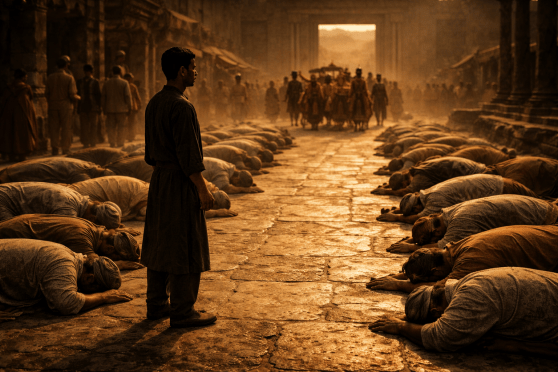
When Haman and his entourage enter and leave the palace each day, the people in the streets were told to bow to Haman. History is filled with examples of what tyrants, monarchs, and dictators can easily make the masses do without question. Haman the Agagite is no different than men who came before him, and many men who would come after him. He commuted to work, and an empire bent at the waist as he passed.

One man refused.

Mordecai.

For days, Mordecai stands while everyone bows. No protest. No screaming about injustice. No raised placards. Just quiet refusal. Bowing is never just political. It is always, at some level, spiritual.

Tyrants, monarchs, and dictators don’t react well to those who refuse to bow. Haman is no different. Dishonored, angry, and enraged by Mordy’s daily refusal to bow, Haman institutes an internal investigation to discover the identity of his ego’s nemesis. That’s when he discovers that Mordecai is a Jew.

Stop right there.

I mentioned in yesterday’s post/podcast that a theme of Esther are things that are hidden. With the revelation of Mordecai’s nationality, there is a hidden plot twist lost to most readers.

When introduced in the story, we learn that Uncle Mordy was a descendant of Kish of the Hebrew tribe of Benjamin.

Reach back into the Great Story hundreds of years and there was another son of Kish of the tribe of Benjamin named Saul. He was the first king of Israel. One of the climactic moments of Saul’s tragic reign happens in 1 Samuel 15. He is fighting against Agag, king of the Amalekites. His instructions were to destroy Agag’s army completely. Saul failed to do so.

Fast forward hundreds of years in the empire of Persia.

Mordecai — descendant of Kish, from the same line as Saul — meets Haman, descendant of Agag.

Saul’s disobedience left a thread unfinished — and history has a way of tugging loose threads.

What goes around, comes around.

In the Great Story, everything is connected.

Mordecai is also not alone in his refusal to bow. He has other compatriots in the same exile who endured another tyrants demand to bow. Their names were Shadrach, Meshach, and Abednego. In fact, they served the previous empire under Nebuchadnezzar with their friend Daniel. Daniel survived to serve the Persian emperor, as well. Mordecai may have even crossed paths with him as an administrator in employ of the same empire. There is a precedent for Mordecai’s quiet courage.

In the Great Story, everything is connected.

Ancient hatreds are rekindled. One man refuses to bow and sparks Haman’s prejudices against an entire people. The second most powerful man in the world’s largest empire decides to kill all the Jews in the Empire. He plots a genocide. Long before there was Hitler and Himmler there was a man named Haman.

The Great Story and our history are also connected. As I mentioned in yesterday’s post, the story God is authoring in me is part of the Great Story He is authoring between Genesis and Revelation.

In the quiet this morning, this leaves me to asking myself an important rhetorical question.

Where do I bow?

The masses in Susa simply bowed. It was practical, safe, and expected.

Only Uncle Mordy stood.

Faith often begins there, not with heroics — just a quiet spine.

One man standing exposes evil, provokes hatred, and begins deliverance. God often writes history through the smallest acts of loyalty. Mordecai’s refusal looks insignificant. But heaven notices loyalty that makes empires rage. And sometimes the whole story turns on one person who stays standing when everyone else kneels.

What would it take to make me bow?

That’s where today’s chapter ends, and where my story connects and continues.

If you know anyone who might be encouraged by today’s post, please share.

Promotional graphic for Tom Vander Well's Wayfarer blog and podcast, featuring icons of various podcast platforms with a photo of Tom Vander Well.
These chapter-a-day blog posts are also available via podcast on all major podcast platforms including Apple, Google, and Spotify! Simply go to your podcast platform and search for “Wayfarer Tom Vander Well.” If it’s not on your platform, please let me know!
An orange square icon featuring an outline of an open book in white

Victim of My Own Poison

So they impaled Haman on the pole he had set up for Mordecai.
Esther 7:10 (NIV)

I once had a person who told me they were angry with me. I had done something to offend, and the person confessed that they knew I had no idea what I had done to hurt them so deeply. I asked what I had done and sought to reconcile, but they chose to not to tell me. Sometime later, I made another appeal and asked the person to share with me what I had done. Again, they chose not to do so.

Two cannot be reconciled if one is unwilling to do so.

Along my life journey, I have encountered many individuals who hold on to their anger, their grudges, their hatred, and their judgments of others. Typically, I find that underneath it all lies a spiritual, relational, and/or emotional wound. The wound often remains carefully hidden beneath all the bitterness and rage. If the wound is not addressed the destructive emotions remain.

I have observed that anger, hatred, grudges, and vengeance are spiritually dangerous things. It has been said that harboring them is like drinking a cup of poison yourself and expecting that it will somehow kill your enemy.

In today’s chapter, the plot twist is downright Shakespearean. Haman’s plot to kill Mordecai and all of the Hebrews is uncovered. Ironically, Haman is impaled on the very pike he had erected for the impaling of his enemy, Mordecai. He allowed himself to drink from the poisonous cup of anger, resentment, bitterness, and rage for so long that he became its victim.

This morning I find myself praying for the person I mentioned at the beginning of this post, as I do whenever that person comes to mind. Perhaps someday the time will be right and they will be ready to talk things out. I hope so. I also find myself taking an internal inventory of my own wounds and examining my own levels of anger, resentment, bitterness and the like. I don’t want to harbor such things lest I find myself the victim of my own internal poison.

Chapter-a-Day Esther 9

dice
(Photo credit: Wikipedia)

Haman son of Hammedatha the Agagite, the enemy of the Jews, had plotted to crush and destroy them on the date determined by casting lots (the lots were called purim). Esther 9:24 (NLT)

The casting of lots was a common practice in ancient times. It was a form of what we would call today “rolling the dice” and letting the future be determined by fate. It’s a practice from which our modern lottery is based. When Jonah was running from God and his ship was being threatened by the storm, the crew cast lots to determine who was to blame for God being so angry. When Jesus’ disciples needed to pick a replacement for Judas Iscariot, they cast lots to decide between the candidates.

While we still have lotteries as a form of gambling and money-making, our culture long ago moved away from trusting in the practice as way of divining God’s will. Today we put our trust more in reason and discernment than to chance.

Nevertheless, I find in the story of Esther and the festival of Purim a reminder that God is not confined to using only the means of our human design and prescription to work His will. I hear in my head some of my stuffy college professors eschewing the idea that God would use anything other than human reason to divine a proper choice. You can’t deny, however, that God worked through both Haman and Esther’s gambles. God used the casting of Haman’s lot to turn the tables on his heinous motives. Esther rolled the dice when she presented herself to the king without being summoned and God used her bet to work His good and perfect will.

Despite our reliance upon knowledge, intellect, and reason, I find that we all face distinct crossroads at different waypoints of our life’s journey. Two paths diverge from our single one and we must make a choice. Sometimes we make reasoned decisions. Sometimes, we roll the dice.  In either case, I believe there is a divine orchestration at work. As it says in Proverbs: “We can make our plans, but the LORD determines our steps” (16:9) and “We may throw the dice, but the LORD determines how they fall” (16:33). Like me, you may have a hard time wrapping your head completely around how that works exactly. There is a divine mystery to it. Proverbs addresses that too: “The LORD directs our steps, so why try to understand everything along the way?” (20:24).


Chapter-a-Day Esther 7

Poison
(Photo credit: Thorius)

So they impaled Haman on the pole he had set up for Mordecai, and the king’s anger subsided. Esther 7:10 (NLT)

I have heard it said that hatred is like drinking a cup of poison with the expectation that your enemy will die. Based on the experiences and observations of my own personal journey, I would expand that definition of that cup’s contents to include anger, bitterness, and prejudice.

Today’s story of Haman is a great example of this principle. Haman’s uncontrollable hatred toward Mordecai leads him to scheme, not only against Mordecai, but also against all of Mordecai’s people. The result is  that Haman himself is impaled on the pike he’d set up for his enemy.

Over time I’ve come to realize just how unproductive and personally destructive negative emotions are both relationally and spiritually. Wander through Jesus’ teachings and you find that the theme is always in choosing the things of God over the things of this world: love over hatred, trust over anxiety, faith over fear, kindness over anger, life over death.

Today, I’m asking God to reveal the pikes I have set up in my own heart:

  • Prejudice against entire groups people whom I don’t know or understand
  • Anger towards those who’ve crossed me
  • Bitterness towards those who long ago injured me
  • Frustrations, fears and anxieties over those whom I cannot control

God, help me take this cup of poison in my hand and pour it out harmlessly to the ground. Then fill it with your love, grace, kindness and mercy. Make me an instrument of your peace.

Chapter-a-Day Esther 6

60th Primetime Emmy Awards
(Photo credit: Wikipedia)

So Haman came in, and the king said, “What should I do to honor a man who truly pleases me?”

Haman thought to himself, “Whom would the king wish to honor more than me?”
Esther 6:6 (NLT)

Wendy and I watched the annual Emmy awards last night on television. I chuckled to myself as I watched. There is no industry like the entertainment industry for sheer self-indulgent self-promotion. Even the host last night made fun of the fact that the Emmy awards were named after who they are really all about: M – E.

The sight of the self-congratulatory television stars came to mind this morning when I read about Haman’s blunder. The contrast between Mordecai and Haman could not be more stark. Mordecai was motivated to do what was right without expecting any reward for it. Haman did what made him look good and expected to be exalted. Haman was blind to the notion that the king would want to honor anyone more than himself.

I learned a long time ago that if you desire recognition you will surely be disappointed. Hard work, doing the right thing and the satisfaction of a job well done produce their own reward. Jesus said:

“Watch out! Don’t do your good deeds publicly, to be admired by others, for you will lose the reward from your Father in heaven. When you give to someone in need, don’t do as the hypocrites do—blowing trumpets in the synagogues and streets to call attention to their acts of charity! I tell you the truth, they have received all the reward they will ever get. But when you give to someone in need, don’t let your left hand know what your right hand is doing. Give your gifts in private, and your Father, who sees everything, will reward you.”

Today, I find myself prompted to do a little heart check. Are my actions and deeds motivated by desire for Hollywood like or Haman like self-promotion and recognition? Or, am I willing to do the right thing without consideration of the earthly cost or human reward?