Tag Archives: Haggai 1

Spiritual Misalignment

Then the word of the Lord came through the prophet Haggai: “Is it a time for you yourselves to be living in your paneled houses, while this house remains a ruin?”
Haggai 1:3-4 (NIV)

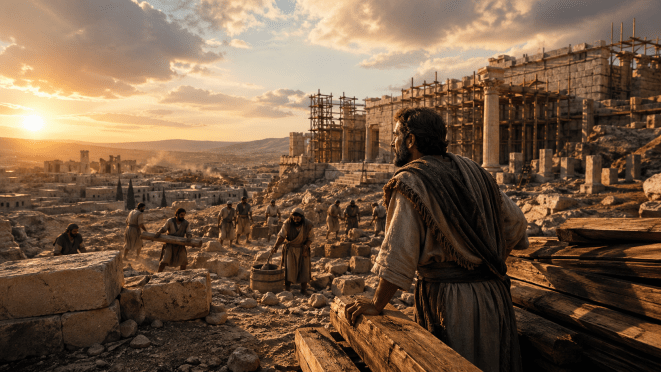
Jerusalem. Around 520 B.C.

The city had lain in ruins for nearly 70 years—reduced to rubble by Babylon, its people carried off into exile.

In the age of Empires, circumstances could change quickly.

The Persian Empire rises, and Cyrus the Great allows a remnant of Hebrews to return to Jerusalem and rebuild their hometown. Under renewed leadership, they begin piecing life back together—first laying foundations, then rebuilding homes for themselves and their families out of the wreckage and debris.

They lay the foundation of the Temple—good start. But opposition rises. Discouragement creeps in. Priorities drift.

For sixteen years they continued to rebuild their homes, businesses, and lives.

Regular trips to the local Lowe’s.
Repairs. Renovations. Upgrades.

Life…moving on.

Meanwhile, Solomon’s Temple — the center of Hebrew culture and the place of God’s presence among His people — remains untouched. A ruined heap of debris.

Enter the prophet Haggai.

His message is blunt, timely, and beautifully uncomfortable:

“Why are you living in comfort while God’s house lies in ruins?”

No fluff. No soft lighting. Just truth walking in, locking the door, and saying, “We need to talk.

The problem wasn’t gross, sinful behavior. It was misalignment.

Their economic struggles—poor harvests, lack, dissatisfaction—are tied directly to this misalignment.

They’re in desperate need of spiritual chiropractic adjustment.

Faith in God was supposed to be their spine, their center — through which all good things flow. But their priorities were desperately out of whack. Their homes were paneled with cedar (the same as Solomon’s Temple), but the Temple was nothing but an empty slab.

They were using temple-quality resources… just not for the temple.

Jesus’ words echoed in my heart this morning as I read: “But seek first his kingdom and his righteousness, and all these things will be given to you as well.” (Matt 6:33).

God’s kingdom had been quietly pushed to the margins of everyday life.

As I meditated on the chapter this morning, I found it fascinating that God’s remedy was as quick as a chiropractor’s crack of the back.

God told them to go up into the mountains, gather timber, and get to work on the Temple.

And then—just like that—they move.
The work resumes.

For me, the pulse under the whole chapter is this:

I am very capable of building a beautiful life…
while quietly neglecting the very thing that gives it meaning.

I upgrade the house.
He points to the foundation.

And here’s the twist—this isn’t condemnation. It’s invitation.
Because the moment the Hebrews turned…
the moment they pick up the timber…
God doesn’t say, “Finally, took you long enough, you ungrateful children.”

He says:

“I am with you.”

That’s the whole game, isn’t it?

Not the building.
Not the output.
Not even the discipline.

Presence.

In the quiet this morning, Holy Spirit whispers questions in my soul:

Where have I been pouring energy into something that can’t quite satisfy?
Where is there misalignment of my priorities?
Where do I need that simple act of alignment?


To hear that whisper again—

“I’m with you…
Now—let’s build something that actually matters.”

If you know anyone who might be encouraged by today’s post, please share.

Promotional graphic for Tom Vander Well's Wayfarer blog and podcast, featuring icons of various podcast platforms with a photo of Tom Vander Well.
These chapter-a-day blog posts are also available via podcast on all major podcast platforms including Apple, Google, and Spotify! Simply go to your podcast platform and search for “Wayfarer Tom Vander Well.” If it’s not on your platform, please let me know!

Insatiable Discontent

“You have planted much, but harvested little. You eat, but never have enough. You drink, but never have your fill. You put on clothes, but are not warm. You earn wages, only to put them in a purse with holes in it.”
Haggai 1:6 (NIV)

This past Saturday night Wendy and I attended the annual awards ceremony for our local community theatre. At the venue, there was a display of the renovation plans for our local Community Center. Some of our faithful community theatre members have been instrumental in generating support for the renovation as it has been the theatre’s home since 1987, and it needs updating.

Along my journey, I’ve come to understand that no large-scale project is universally loved and appreciated. No matter what you propose, there’s going to be opposition. Momentum and support for interest, funding, and investment require advocates willing to campaign for the cause. Thus, the members and their impressive display at the awards ceremony.

Over the last several months, I have been blogging through the “exilic” books which recorded that stories and accounts of the Hebrew people taken into captivity when Babylon besieged and destroyed Jerusalem around 600 B.C. A large contingent was taken into exile in Babylon and Persia (modern day Iraq) for 70 years. Then, many of the exiles returned to Jerusalem to resettle in their homeland, rebuild their city, and reconstruct the Temple which was in ruins.

The prophet Haggai wrote and preached among the returned exiles. Like any other major civic building project, the rebuilding of the ruined temple was not universally supported. In today’s opening chapter, Haggai clearly states the theme of the message that God had given him to address, which was a pointed call to rebuild the temple.

What I found interesting was the problem that Haggai called out, which was delaying the project: insatiable discontent. The people incessantly believed that they never had enough, and they perpetually wanted more for themselves. Life was an all-you-can-eat buffet and their appetites always brought them back to the line for more. That left little interest, support, or investment in rebuilding God’s temple.

In the quiet this morning, I am reminded of Jesus’ consistent words and example in advocating that His followers reject insatiable discontent that is so prevalent in our world, and invest in things of eternal value:

“You’re blessed when you’re content with just who you are—no more, no less. That’s the moment you find yourselves proud owners of everything that can’t be bought.”

“You’re blessed when you’ve worked up a good appetite for God. He’s food and drink in the best meal you’ll ever eat.”

“Are you ready to rough it? We’re not staying in the best inns, you know.”

Jesus sent his twelve harvest hands out with this charge: “Don’t think you have to put on a fund-raising campaign before you start. You don’t need a lot of equipment. You are the equipment, and all you need to keep that going is three meals a day. Travel light. When you enter a town or village, don’t insist on staying in a luxury inn. Get a modest place with some modest people, and be content there until you leave.”

“What I’m trying to do here is to get you to relax, to not be so preoccupied with getting, so you can respond to God’s giving. People who don’t know God and the way he works fuss over these things, but you know both God and how he works. Steep your life in God-reality, God-initiative, God-provisions. Don’t worry about missing out. You’ll find all your everyday human concerns will be met.”

Jesus (excerpts taken from The Message)

The problem Haggai addressed with the returned exiles is a basic human problem. He couldn’t motivate people to invest in God’s house because they were never content with their own. Jesus addressed the same problem in His day. Human nature hasn’t changed in 2000 years. My basic human nature is continually given to insatiable discontent. There is always something in life’s all-you-can-eat buffet line beckoning to come back for more. I find myself needing a constant reminder of Jesus’ call to switch my appetites from the things of this world to His eternal Kingdom.

Chapter-a-Day Haggai 1

source: sualk61 via Flickr

This is what the Lord of Heaven’s Armies says: Look at what’s happening to you! You have planted much but harvest little. You eat but are not satisfied. You drink but are still thirsty. You put on clothes but cannot keep warm. Your wages disappear as though you were putting them in pockets filled with holes! Haggai 1:5-6 (NLT)

As you might suspect if you’ve been following my blog for any length of time, I like to write. In fact, there are a couple of books and plays rattling around in my head most of the time. Ask me the question, “If you were going to write a book, what would it be?” and I’d have to start flipping coins to narrow it down to one. I can tell you for sure that these verses from today’s chapter would definitely be referenced in one of them.

As I look back on my journey, I find that the theme of contentment has largely been ignored by Jesus followers and the church organization. Even though God’s Message reminds us to be content in any and every circumstances, the louder voices of our culture and our economy cry for us to be continuously discontent. Historians will tell you that we are in the “Age of Technology” and nothing has tapped into our spirit of discontent like technology. The must have gadget or device we buy today is replaced by a newer, better, faster gadget or device tomorrow. Welcome to the hamster wheel. Start spinning.

I don’t write this to judge anyone but myself. I am increasingly convicted that I have given in to the spirit of discontent as much as anyone. My daily introspection and self-examination often leads to a conversation with God in which I’m asking forgiveness for not being content in one fashion or another. I am reminded again this morning that Jesus said the road to life is narrow, difficult, and runs against the bumper-to-bumper traffic on the super highway towards death. In God’s economy, godliness coupled with contentment are the means of great gain.

Maybe I should write that book: The Case for Contentment.

I’m afraid no one would be interested.