Tag Archives: Felix

To Appeal, or Not?

To Appeal, or Not? (Cad Acts 25) Wayfarer

“If, however, I am guilty of doing anything deserving death, I do not refuse to die. But if the charges brought against me by these Jews are not true, no one has the right to hand me over to them. I appeal to Caesar!”
Acts 25:11 (NIV)

Paul has been imprisoned for two years. He had been a political blue-chip for the Roman Governor, Felix, who wanted to stay on the good side of the Jewish rulers who wanted Paul dead. Paul gave him leverage. Felix gets recalled to Rome and a new Governor named Festus arrives. As Festus gets the political lay of the land, he quickly understands that the trial and fate of Paul is a political hot potato.

Festus begins with a political gesture to his Jewish constituents by traveling to Jerusalem to visit them on their home turf for a little over a week. Obviously, there were a number of political issues to discuss, but Paul’s fate was certainly on the list of Jewish demands.

Upon arriving back in his seat of power in Caesarea, Festus convenes the court and brings in Paul to hear Paul plead his case. Festus, still in a conciliatory mood with the powerful Jewish faction under his rule, asks Paul if he’s willing to be tried by the Governor in Jerusalem.

In this moment, Paul makes a decision that will seal his fate and determine the rest of his earthly journey. We know that Jesus had appeared to Paul and told him he must testify about Him in Rome (Acts 23:11). It is entirely possible that Paul was afraid that the new Governor, clearly trying to appease the Jewish rulers, would take him to Jerusalem and hand him over to them. To ensure that he would testify in Rome, Paul used his legal right under Roman law to appeal his case to Caesar in Rome itself. In doing so, Paul ties Festus’ hands politically. Festus is bound by duty to send Paul to Rome.

Along my life journey, I have encountered followers of Jesus who believe that God has called them to do this or that. Subsequently, I have watched individuals try to make it happen. In some cases, the results have been disastrous, much like Shakespeare’s Macbeth. It has left me believing that if God’s purpose is for me to go here or there and do this or that, then nothing can stop it from happening.

Was Paul’s appeal to Rome necessary or not? If God wanted Paul to testify in Rome, could/should Paul have trusted that God would see to it he won his trial in Jerusalem so he could travel to Rome of his own free will? Was his appeal to Caesar an act of obedience or an act of doubt? We’ll never know.

I have found along the way that God’s purposes and my free will are a lot like the mysterious circle dance of Father, Son, and Holy Spirit in which One is Three and Three are One. There’s a tension. On one hand I can be too passive and think I’m trusting God to make things happen. On the other hand, I can willfully try too hard to make things happen and think I’m being obedient to what God has purposed for me.

Life is a bit like the Waverunner we have at the lake. If you don’t have your finger on the accelerator and are propelling yourself forward, you can’t steer the thing. My part is to willfully and obediently walk in discipleship (propelling myself spiritually forward). Then, I can trust God to steer me where He ultimately purposes for me to be.

If you know anyone who might be encouraged by today’s post, please share.

Political Imprisonment

Political Imprisonment (CaD Acts 24) Wayfarer

At the same time {Governon Felix] was hoping that Paul would offer him a bribe, so he sent for him frequently and talked with him.
Acts 24:26 (NIV)

Wendy and I are long-time readers of the Wall Street Journal. Over the past year, we’ve been following the case of Evan Gershkovich, a WSJ journalist in Russia, who has been arrested and imprisoned on a trumped-up charge of espionage. It is a game the Putin regime plays on a regular basis, arresting high-profile individuals who can be traded for his henchmen who have been captured in the West. It’s a terrible situation for the victims like Gershkovich who’s done nothing to deserve his fate, but it has worked time-and-time-again for Putin, so he’ll keep doing it. It’s the way the world works.

In today’s chapter, Paul is tried before the Roman Governor, a corrupt and incompetent leader named Felix. Felix only lasted a few years as Governor and was eventually recalled to Rome to answer for his poor leadership.

It’s easy to miss the political game into which Paul has been swept, but it’s important context. Paul has one motivation: To be a witness of Jesus, His resurrection, and the eternal salvation He offers. For every other player in the events of these final chapters of Acts, their motivations are personal and political.

The Roman Empire holds sway throughout the Western world. The Empire’s prevailing desire is to maintain power, maintain peace, and keep tax revenues flowing to Rome. In Judea, keeping the peace means dealing with the Jewish leaders who control the Jewish population. The Jews hate the Romans and the Romans despise the Jews, but they have to deal with one another.

To complicate the issue, Paul was born a Roman citizen. His parents were tentmakers in Tarsus, and were likely providers of tents for the Roman legions. It’s speculated that their family may have been granted citizenship for their service in outfitting Roman armies, or perhaps they were wealthy enough to purchase citizenship.

Being a citizen of Rome was not something every person born in the Empire received like you do in countries like the United States. Citizenship had to be purchased or granted, and relatively few people had it. Roman citizenship was more like having an elite status with the airlines that gave you all sorts of perks like free first-class upgrades that the majority of fliers back in economy class could only dream about.

The Jewish ruling council couldn’t just deal with Paul as they did Jesus, who was a nobody in Rome’s eyes. Rome took care of its citizens, which means Felix has a political blue-chip in Paul. The Jews want Paul dead, but Felix holds the power to give them what they want or hold on to Paul and string them along just to make them mad. Furthermore, being a citizen was typically a sign of wealth, and Paul’s testimony was that he came to Jerusalem with money for the poor. If Paul has access to money, perhaps he will offer Felix a bribe for his release. Felix doesn’t care about Paul. He cares about himself, his pocketbook, and his power.

The thing I found fascinating as I meditated on the chapter this morning is to compare Paul to everyone else in the situation. Paul is simply a disciple of Jesus who is focused entirely on bringing God’s Kingdom to earth in any and every way he can. This is such a contrast to both Felix and the Jewish leaders who represent people of this world, living for this world, and representing kingdoms of this world. Felix keeps summoning Paul for conversations hoping Paul will offer him a bribe. Why would Paul offer Felix a bribe? Paul cares more about the opportunity to talk to Felix, the Roman Governor, about Jesus than he cares about his freedom.

In the quiet this morning, I can’t help but wonder how I might fare if I were unjustly arrested and detained simply because of my faith. As I think about it, I tend to think that the situation would reveal a lot about me and that which I believe. If I am focused on this life and the things of this world, then it would likely cause all sorts of spiritual, mental, and physical anguish. If, however, I am focused on God’s Kingdom and His righteousness, then I suspect I have a completely different attitude entirely.

Of course, I hope never to end up in those circumstances. Yet, as I reflect on it in the quiet, I realize that the same contrast exists today as I live in freedom and affluence. Do my life and my actions reflect a person who is living for this world and the things of this world, or do they reflect a person living to bring God’s Kingdom to earth?

If you know anyone who might be encouraged by today’s post, please share.

The People v. Paul of Tarsus (Part 2)

If, however, I am guilty of doing anything deserving death, I do not refuse to die. But if the charges brought against me by these Jews are not true, no one has the right to hand me over to them. I appeal to Caesar!”
Acts 25:11 (NIV)

Our daughter and her family recently moved to the United Kingdom along with some good friends who were scheduled to leave about the same time. On the the eve of their departure, their friends were still dealing with a snafu with their visas. As they explained it to me, the whole affair became maddening cluster of a situation involving frantic phone calls, an attorney, government bureaucracy, and university bureaucracy. The maddening situation ultimately delayed their departure for an indefinite period of time and kept them in hurry-up and wait limbo.

As we enter today’s chapter, Paul has been imprisoned in a similar “hurry up and wait” limbo in the regional Roman justice system. The Roman Procurator, Felix, had kept Paul in prison for two years as a favor to the powerful Jewish leaders in Jerusalem. Felix is replaced with a man named Festus to who begins his tenure in office with a diplomatic mission to Jerusalem where the Jewish religious leaders urge him to return Paul to Jerusalem (so they could assassinate him). Festus makes a political countermove by urging them to come to Caesarea and make their accusations.

In Part 2 of Paul’s trials the Jewish leaders make their accusations. Once again they have no evidence and accuse Paul of nothing that would be deserving of death. Festus, however, is a new Procurator playing a political game of chess with the political players of his region. He attempts to appease the Jewish religious leaders by asking Paul if he’d be willing to go to Jerusalem and let the case be heard there.

Paul knows that this is a mockery of Roman justice being suggested for political gain. To return to Jerusalem would only pander to his enemies and accusers. It’s essentially a step backwards and to agree would place him in a weaker position. Festus obviously wants to appease Paul’s accusers and Paul can smell a rat. If Festus is willing to try the case in Jerusalem, outside of Roman civil court, then he just might be willing to make Paul a sacrificial offering to shore up his political position.

Paul now makes a bold move and appeals to Caesar. This is a bold move because Festus has not actually tried Paul’s case and has not rendered a verdict. It was a risky move because Festus might have ultimately released Paul. The case against Paul was weak and executing a Roman Citizen for political gain with the Jews would not have been a good political move within the Empire. It was also risky because appealing to Caesar meant being sent to Rome and more languishing in the Roman justice system for an indefinite time. Paul also knew that his surprise appeal would give Festus a political out: “Sorry guys. I tried to bring him to Jerusalem to stand trial, but he appealed to Caesar. He’s a Roman Citizen. My hands are legally tied.”

As a read this morning I find myself, once again, trying to crawl into the mind of Paul. Paul clearly stated when he went to Jerusalem was that his motivation is to expand the Message of Jesus and to proclaim the Message across new boundaries. He wants to push the Message forward. The prospect of a return to Jerusalem would only put him back where he’s already been for years. The appeal to Caesar, while risky, offered the potential for his story and his witness to become a matter of official public record in the Roman Empire. In essence, Paul’s deft legal maneuver assured that he wouldn’t be the sacrificial lamb for Festus’ political gain, but he would willingly sacrifice himself for the sake of Jesus and taking the Message of Jesus to the very heart of the Roman Empire.

Being stuck in the limbo of bureaucracy can be maddening. Just ask Taylor’s friends about their experience. I find that Paul, however, is finding purpose in the pain of his situation. It comes down to motives. His ultimate motivation is not about his physical freedom, but freeing others by furthering the Message of Christ. With that in mind, he’ll use his circumstances to achieve his goal.

The People v. Paul of Tarsus (Part 1)

Several days later Felix came with his wife Drusilla, who was Jewish. He sent for Paul and listened to him as he spoke about faith in Christ Jesus.
Acts 24:24 (NIV)

I and my team at work have had many different business engagements over the years with a number of very different companies. I’m glad to say that our team has had several on-going engagements with clients that have lasted 15, 20, and even 25 years and counting. Others engagements have been relatively small projects that lasted a week or a month. The difference between a long engagement and a short one is often dependent the level of person we’re working with within the organization.

If we’re working with the CEO and/or senior executives of a client company, we have the opportunity to positively influence the client’s entire operation along with the  health and well-being of the customer experience for decades. A middle manager, on the other hand, typically has limited means and influence. They usually bring us in for a moment in time to treat a symptom in their service delivery system.

In today’s chapter, we find Paul in the midst of a tectonic shift in his ministry. For years he has traveled the Roman Empire in Judea, Asia Minor, and Greece. He’s been among the people. He’s expanded the number of believers and followers of Jesus. He’s organized them into local groups. He’s provided for himself by keeping his day job as a maker of tents. Paul has been on a grass-roots, boots-on-the-ground, non-stop mission among the common, everyday people in the streets. Now, like Jesus before him, Paul finds himself in the justice system of the Roman Empire being accused by the leaders of the Hebrew religion who want him dead. Unlike Jesus, Paul is a citizen of Rome, and that affords him the ability to appeal his case all the way to Caesar himself.

The first trial Paul faces against the religious leadership of the Jews is before the Roman Procurator, Antonius Felix, who had authority over Judea. Felix, like many Roman regional authorities of the time, was a corrupt official with a reputation for both cruelty and debauchery. The trial, as recorded in today’s chapter, should have ended with Paul’s release. The Jewish leaders had no accusation that should have stood up in Roman court. They did not produce a single corroborating witness willing to be cross-examined, and they had no evidence. Paul’s defense was persuasive and, as a Roman citizen, he should have been released immediately. Felix, however, was in a tough spot politically.

One of the top responsibilities of Roman provincial leadership was keeping the peace. The Jewish leaders bringing charges against Paul had tremendous political and social influence, and Felix knew it. His predecessor, Ventidus Cumanus, failed to respond to a racially motivated murder of a Jew in Samaria. The result was riots and uprising. Cumanus was held responsible by Caesar and exiled. Felix wants to avoid this fate so he decides to appease the Jewish leaders by keeping Paul in prison. But the Jesus movement has been gaining popularity, as well. Tens of thousands of people had become believers and Paul is one of their leaders. So, Felix can’t just have him killed without potentially igniting a backlash.

The compromise Felix came up with was to keep Paul under a relatively comfortable house arrest within the palace. For two years Felix and his wife (the daughter of Herod Agrippa) regularly meet with Paul to have lengthy discussions. Felix, being a corrupt Roman official, is hoping Paul will offer him a bribe to let him go. Paul is on a very different mission, however. He could have easily stolen Peter’s line: “Silver and gold I don’t have, but what I have I give to you.”

This morning as I read, I thought about Paul’s situation in terms of my own experience in business. For years Paul has been working with the front-line workers of the corporate Roman Empire. Now Paul finds himself invited into the executive suite. Paul has the opportunity to influence an influencer. To convert a Roman official, to even make him aware of the Message of Jesus, could have a tremendous ripple effect throughout the Empire. Paul is fulfilling the very mission Jesus spoke of to his disciples: “On my account you will be brought before governors and kings as witnesses to them and to the Gentiles.” (Matt 10:18)

Convert an Ephesian shopkeeper and you change a life. Convert a Roman official and you might just change an empire (which is exactly what eventually happened two hundred years later with the Roman Emperor Constantine).

God and His Resources

paul before felix

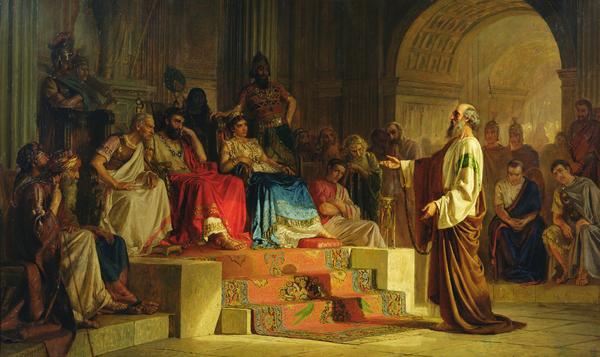
At the same time he hoped that money would be given him by Paul, and for that reason he used to send for him very often and converse with him. After two years had passed, Felix was succeeded by Porcius Festus; and since he wanted to grant the Jews a favor, Felix left Paul in prison. Acts 24: 26-27 (NRSV)

Over two years Paul was imprisoned by Governor Felix. Over two years he lived under house arrest. No crowds got to hear Paul speak. Paul did not get to journey from town to town speaking to and encouraging fellow believers. For over two years Paul basically had an audience of one Roman Governor and his wife who would occasionally send for him to have a conversation.

I’ve learned along life’s road that God’s ways are not always our ways. We tend to look at Paul’s imprisonment and think what a waste to have Paul languishing under house arrest when there were so many other things he could have been doing with his time and talents. I wonder if Paul thought that too, or if he was content knowing that he was right where he was supposed to be and doing what he was supposed to do.

Sometimes we have to trust that God knows what He is doing with the use of His resources.