Understand, then, that it is not because of your righteousness that the Lord your God is giving you this good land to possess, for you are a stiff-necked people.
Deuteronomy 9:6 (NIV)
Yesterday’s post faded to black with me and Wendy sitting at the breakfast table naming our blessings and whispering after-meal blessing of gratitude. If I’m not careful, this chapter-a-day journey too easily compartmentalizes each chapter. While I love the rhythm of letting one chapter speak in to my day, I try not to forget that there is a flow to the text. Yesterday’s chapter and today’s chapter are connected.
Yesterday’s chapter and my meditations fit hand-in-glove with the Christmas season. My soft heart loves Christmas. Every day brings cards and photos of family and friends we don’t see often enough. With each one are fond memories and good feelings. Wendy and I have been watching beloved Christmas movies (yes, Die Hard is a Christmas movie) and feeling all the feels. Family gatherings are planned. I can feel the desire to be together, to name our blessings, and to feel the gratitude.
This is sentimental remembering. Warm feelings, meaningful memories, and full hearts that feed the positive emotional endorphins. That’s where I exited yesterday’s post.
Today’s chapter, however, channels a very different kind of remembering.
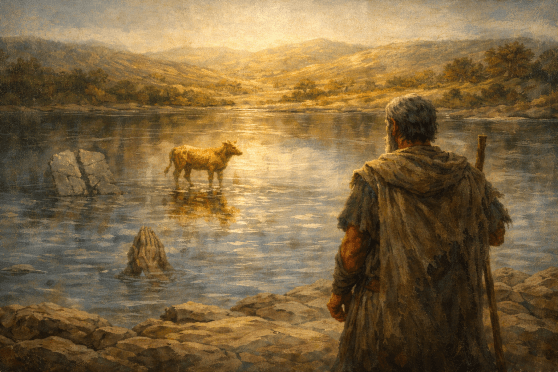
Moses stands at the Jordan River with this next generation of Hebrews gazing across at the Promised Land. They are about to cross over and take possession of it while Moses stays behind and takes his final earthly breath. They will take the land. They will be blessed. They will prosper. But, Moses tells them, there is a truth that needs to sink deep into their hearts before they set out. It is a truth so spiritually vital that Moses repeats it three times like Jesus asking Peter three times: “Do you love me?”
…do not say to yourself, “The Lord has brought me here to take possession of this land because of my righteousness.” (vs. 4)
It is not because of your righteousness or your integrity that you are going in to take possession of their land… (vs. 5)
Understand, then, that it is not because of your righteousness that the Lord your God is giving you this good land to possess, for you are a stiff-necked people. (vs. 6)
Moses then painfully and deliberately hits the rewind button:
Golden calf.
Stiff necks.
Tablets shattered like dropped china.
Tear-stained intercession that kept the nation from annihilation.
The message lands bare and unflattering:
You didn’t earn this.
You didn’t deserve this.
And you still don’t.
Which—oddly enough—is very good news.
This is what is known in Hebrew as zakhor—not memory as the emotional fog of sentimentality, but memory as moral restraint.
It is Cain remembering the stain of his own brother’s blood on his hands.
It is Abraham remembering the painful casting away of Hagar and his son Ishmael.
It is Israel remembering that he was a deceiver who stole his brother’s blessing.
It is Moses remembering his murder of an Egyptian overseer, fleeing for his life, and his years of living on the lam in Midian exile.
It is David remembering his adultery with Bathsheba, his murder of her husband, and the death of their first-born child.
It is Paul seeing the face of Stephen and all of the other believers he persecuted and had executed before he met Jesus on the road to Damascus.
It is me remembering my long list of moral failings. Failings that trace all the way back to being a five-year-old stealing all the envelopes of Christmas cash off of Grandma Golly’s Christmas tree and hiding them in my suitcase.
In the quiet this morning, sentimental twinkle-light memories get balanced with the sobriety of zakhor memories. Moral memory isn’t shame, it’s schooling. It’s not reproach, it’s reinforcement of reality.
All of this abundance of blessing that surrounds me each day? The blessing that is so abundant that I sometimes forget that’s it’s a blessing?
I didn’t earn this.
I didn’t deserve this.
And I still don’t.
“For it is by grace you have been saved, through faith—and this is not from yourselves, it is the gift of God— not by works, so that no one can boast.”
Moses is channeling the Gospel of Jesus 1500 years before Bethlehem.
As I soak in a little moral remembering this morning, I find my heart humbled. Like the Hebrews standing on the border of the Promised Land, I find myself chosen, called, and blessed – not because of who I am and what I’ve done but despite it.
Sometimes the fog of sentimental remembering lulls me into thinking that blessing is an entitlement. Moral remembering cuts through the fog and grounds me in the reality of His grace.
As Bob Dylan sings,
“like every sparrow fallen,
like every grain of sand.”

If you know anyone who might be encouraged by today’s post, please share.