Tag Archives: Deuteronomy 22

Controlled Burns

If a man is found sleeping with another man’s wife, both the man who slept with her and the woman must die. You must purge the evil from Israel.
Deuteronomy 22:22 (NIV)

It’s a chilly winter morning in Iowa. The rolling fields lie barren — a mosaic of brown and gray, flecked with snow like the scattered brushstrokes of an Impressionist. When spring and summer return, new life will repaint the land in vivid color.

This past year I had the joy of accompanying a friend on a plane ride. It’s a beautiful way to gain a gorgeous perspective on the patchwork quilt that is the Iowa landscape from above. As we soared around the state I was struck by pillars of black smoke that rose from the green fields like little black threads emerging from the quilt.

Controlled burns.

Controlled burns are a part of the stewardship and management of the land. It’s not scorched earth. It’s agricultural surgery — burning away what would otherwise become terminal. It ensures that healthy new life can emerge and flourish from the land.

There is a repeated phrase God through Moses uses to address His Hebrew children as they prepare to enter the Promised Land:

“Purge the evil from among you.”

It clanks on the table every time God drops it into the text. It’s like cold iron. It sometimes feels like shackles of condemnation that don’t fit with the God who loosened the shackles of slavery and is all about freedom and life. I’ve been on this trek through the Great Story long enough to know that when the text chafes, it’s often not the original message, but the English translation. So, I went down the rabbit hole this morning to study the original Hebrew.

What I discovered is that what sounds like a scorched earth of condemnation in the English language is really God’s design for controlled burns that stem chaos and perpetuate Life.

The word for purge is actually more of an agricultural word used for burning chaff, removing what chokes growth, and clearing that which corrupts the whole.

The word for evil is not what is easily interpreted as “badness” (echoes of Santa’s naughty list) but in Hebrew is about that which breaks “shalom” within the whole. Less personal “naughty acts” (think a cancer cell) and more “that which leads to corruption” (think Stage 4 cancer spread).

The word for among you is equally as telling. It’s intimately internal. It’s womb-space where Life emerges. God is calling His people not to “destroy what’s out there” but to “address what’s inside me – that which will destroy from the inside out.”

  • Purge → controlled removal
  • Evil → that which fractures shalom
  • Among you → the inner, generative space

If I read today’s entire chapter through the lens of considering those attitudes and actions within me that can have devastating ripple effects in the lives around me and spread to the larger community, I begin to see it in a while new light.

I couldn’t help but notice that this phrase was directly linked to the sin of adultery. Both the man and the woman caught in the act of adultery were to be held accountable. Adultery tears at the fabric of relationships and trust. It tears souls apart. It tears lives and families apart. It consumes shalom in the backdraft of its blaze of unrestrained passion.

This thought immediately transported me to John 8. In front of Jesus is a naked, crying, humiliated woman. She was dragged from her adulterous bed by an angry mob and dragged before the Son of God. The mob of angry, self-righteous religious men have rocks in hand ready to carry out Deuteronomy 22:22 to the black-and-white letter of the law. They are ready to purge the evil of this wicked woman from among them.

But, where is the man who was in the adulterous bed with her?

The law demanded accountability from both. The mob delivered shame to one.

Jesus was facing what corrupted humanity does with God’s design. It rigs the system. The powerful get a pass. The despised are be self-righteously condemned and rejected. Hatred, prejudice, and injustice, masquerading as religion, flourish and cauterize the souls of those building their personal spiritual empires in God’s name. The men were following the letter of the God’s Law that served their self-righteous interests, but they completely ignored the heart of God’s Law with their actions. In so doing, they ensured the perpetual slow death of shalom among them.

This same religious mob would soon repeat the pattern. They will self-righteously proclaim to be keeping God’s Law as they ignore the very heart of it as they condemn the Son of God to die on a cross.

In the quiet this morning, God’s Spirit whispers for me to consider the direction of my gaze. Today’s chapter is not calling me to gaze “out there” for the evil around me to condemn and burn in my own version of a scorched earth inquisition. God in today’s chapter is calling me to gaze inside my inner place, into the very womb of my soul from which God wants to perpetuate radiating, freedom-producing, shalom-filled Life.

What spiritual cancer cells threaten to infect my soul?

Anger?
Hatred?
Selfishness?
Indifference?
Bitterness?
Scarcity?

It starts with me. If I want new Life to flourish in and around me like the gorgeous ocean of bumper crops in a late Iowa summer, then I have to consider the controlled burns required. I have to address that which threatens shalom in my own field; Those unhealthy attitudes and motives which, unaddressed, radiate out into my thoughts, words, and actions to infect my relationships and all of my circles of influence.

As I lace ‘em up for this another day on this earthly journey, I’m not so much thinking about what’s out there. I’m thinking about what’s in me. If I don’t take responsibility for what’s in me, I can’t pretend to be a solution for what’s out there.

If you know anyone who might be encouraged by today’s post, please share.

Promotional graphic for Tom Vander Well's Wayfarer blog and podcast, featuring icons of various podcast platforms with a photo of Tom Vander Well.
These chapter-a-day blog posts are also available via podcast on all major podcast platforms including Apple, Google, and Spotify! Simply go to your podcast platform and search for “Wayfarer Tom Vander Well.” If it’s not on your platform, please let me know!
An orange square icon featuring a simple white open book illustration.

Context and Color

If a man is caught lying with the wife of another man, both of them shall die, the man who lay with the woman as well as the woman. So you shall purge the evil from Israel.
Deuteronomy 22:22 (NRSV)

The ancient books of law are not always an easy, inspirational read. I like it, however, when I come across something that provides a layer of context and color to other stories in God’s Message. Today is a good example. The law of the ancient Hebrews was  that when a man and woman committed adultery they were both guilty and were to be punished by being stoned to death.

In John’s biography of Jesus there is the story of a woman caught in adultery. The religious leaders brought the woman before Jesus, stones in hand, asking Jesus to render judgment whether they should stone her to death. But, according to the law we read into today’s chapter, both the man and woman were to be stoned. So, where was the man?

The context helps provide evidence of why Jesus was so angry with the religious leaders of that day who liked to use the letter of the law when it worked to their own advantage, while they conveniently ignored the parts that weren’t. Jesus deftly handles the situation by telling the religious leaders that whichever one of them is without sin could cast the first stone. The religious leaders split and Jesus forgave the woman and sent her on her way.

Today, I’m thinking about my own heart and life. Who do I most resemble in the story? The religious hypocrite using God’s Message for my own advantage? The disgraced sinner doomed to die? Or am I like Jesus, extending grace and mercy to the condemned? As I sit here in the morning quiet I must admit that I am a mixture of all three. Today, I want to be more the latter and less the former.

chapter a day banner 2015

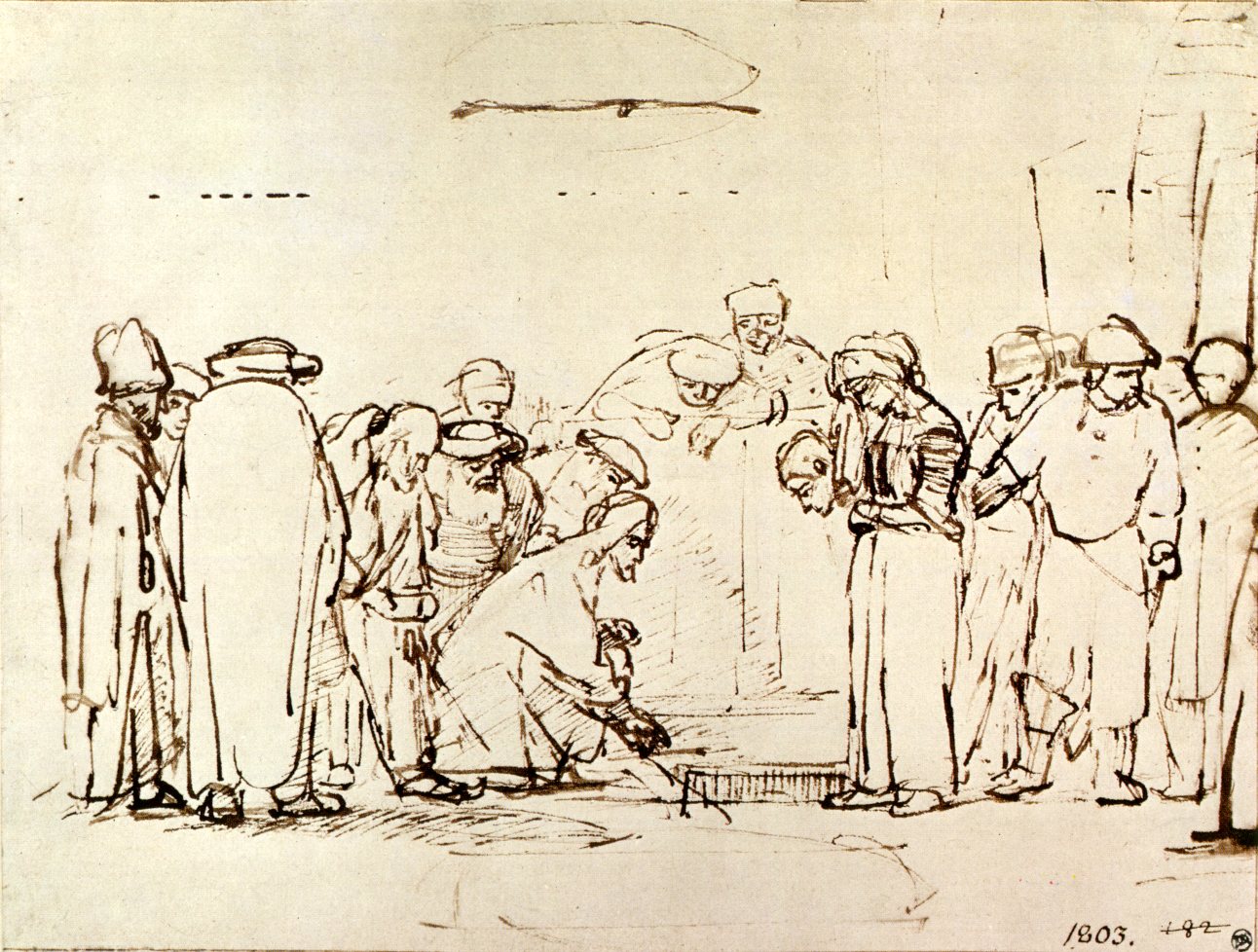
featured image by Rembrandt van Rijn (wikipedia)

Chapter-a-Day Deuteronomy 22

Jesus and the woman taken in adultery.
Image via Wikipedia

If a man is found sleeping with another man’s wife, both must die. Purge that evil from Israel. Deuteronomy 22:22 (MSG)

One of the reasons that I love the journey through the Old Testament is that it helps bring important perspective on the familiar stories of the New. Take the law I pulled out of today’s chapter, for example. When I read it, I immediately thought of a familiar story from John’s biography of Jesus:

 Jesus went across to Mount Olives, but he was soon back in the Temple again. Swarms of people came to him. He sat down and taught them. The religion scholars and Pharisees led in a woman who had been caught in an act of adultery. They stood her in plain sight of everyone and said, “Teacher, this woman was caught red-handed in the act of adultery. Moses, in the Law, gives orders to stone such persons. What do you say?” They were trying to trap him into saying something incriminating so they could bring charges against him.

Jesus bent down and wrote with his finger in the dirt. They kept at him, badgering him. He straightened up and said, “The sinless one among you, go first: Throw the stone.” Bending down again, he wrote some more in the dirt.

Hearing that, they walked away, one after another, beginning with the oldest. The woman was left alone. Jesus stood up and spoke to her. “Woman, where are they? Does no one condemn you?”

“No one, Master.”

“Neither do I,” said Jesus. “Go on your way. From now on, don’t sin.”

All of a sudden, there is greater complexity in the story of the woman caught in adultery and I have a greater appreciation for what Jesus did. Knowing that the law specifically called for both the man and woman caught in adultery to be killed, Jesus was wondering “where’s the dude?” But, Jesus didn’t make it a legal argument, he made it a personal argument. Rather than pointing them to the law, Jesus pointed them to their own sin and shortcomings.

God’s Message tells a story from beginning to end. I may have my favorite chapters, but I will never have the whole picture if I don’t know the whole story.

Enhanced by Zemanta