Tag Archives: Decency

Stories and Choices

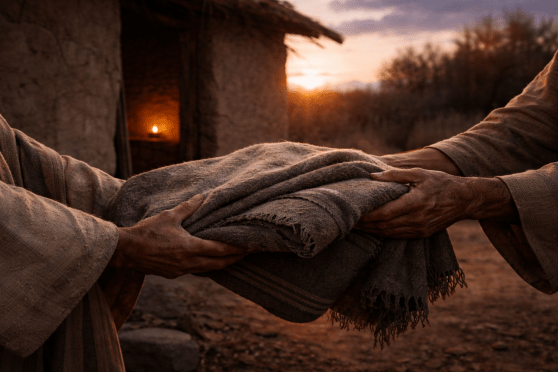
If the neighbor is poor, do not go to sleep with their pledge in your possession. Return their cloak by sunset so that your neighbor may sleep in it. Then they will thank you, and it will be regarded as a righteous act in the sight of the Lord your God.
Deuteronomy 24:12-13 (NIV)

Along this chapter-a-day journey, I have often referenced being a historian of my family. I was a young man when I began really digging into the past and peeking into the dusty corners of the proverbial family attic. At that point in my life journey I was on a quest of self-discovery.

My quest has revealed many things over the years. I discovered plenty of the things families don’t talk about. Most all of the flaws of everyday humanity were lurking there. I learned stories of addiction, adultery, divorce, suicides, illegitimate children, and individuals leading secret second lives.

There was also plenty of dark tragedy that was brought to light. One of my great-great grandmothers was farmed out to be a live-in housekeeper for a distant family. When one of the sons of the family got her pregnant and refused responsibility, she was left with few options. Her own sister took her in, but forced her to live in Cinderella-like seclusion not wanting anyone to know she was there.

I learned that one of my great-grandmothers was a gold digger whose many failed marriages reaped tragic results for her and two of her children.

What I also witnessed in learning my family stories, however, is a lot of human decency. My grandparents for years took care of an elderly widow who lived down the block and had no one else to care for her. I had a grandfather who gave his deadbeat alcoholic brother a second chance. He quietly did the right thing by his family even after his family unjustly gave him the shaft. There are stories of financial generosity, giving friends a place to live, helping friends and neighbors with goodness and loving kindness.

“Remember” is a word Moses uses three times in today’s chapter. He returns to what Jewish teachers called zakhor, memories that help build moral muscle.

Today’s chapter is a collection of rules Moses gives his children and grandchildren as he prepares to send them off into life while he himself lies on his deathbed. The thread that I found running through Moses’ directives is basic human decency.

Divorce with decency for the woman who has zero power or standing in the culture of that day.

Don’t take a millstone—someone’s livelihood—as collateral, and leave them with no means to earn a wage.

Don’t treat your own people with contempt.

A person may owe you money and give you their cloak as collateral, but you return that cloak before nightfall. Don’t leave the poor soul cold at night.

You don’t kill children as justice for their parent’s wrongdoing, nor kill a parent for their child’s wrongdoing. Justice is for the offender, not their family.

Pay your employees promptly. Do right by those who work for you.

Do right by the poor and needy, as well. Leave harvest leftovers in the field and on the limbs and vines for the stranger, orphan, and widow to pick and eat.

As I meditated on all these things, I realized that today’s chapter was the foundation on which Jesus’ built His teaching. It’s doing right by others. It’s treating others the way I’d want to be treated. It’s using whatever authority, power, and means God’s blessed me with to love, serve, and provide – not just to those I know and love, but to those in need, even strangers, foreigners, and enemies.

In the quiet, my own zakhor memory rummaged through all of my family stories. Those stories include examples of individuals who, by faith, embodied the loving-kindness and generosity Moses (and Jesus) prescribe in today’s chapter – and those who didn’t.

This leaves me with the realization that I have a choice.

I can join one group or the other in the collective legacy of zakhor memories my great-great grandchildren will inherit. My choice is determined in a million daily thoughts, words, and actions.

If you know anyone who might be encouraged by today’s post, please share.

Promotional graphic for Tom Vander Well's Wayfarer blog and podcast, featuring icons of various podcast platforms with a photo of Tom Vander Well.
These chapter-a-day blog posts are also available via podcast on all major podcast platforms including Apple, Google, and Spotify! Simply go to your podcast platform and search for “Wayfarer Tom Vander Well.” If it’s not on your platform, please let me know!
An orange icon featuring an open book with a white outline, representing reading or educational content.

Chapter-a-Day Isaiah 20

Shocked! God told Isaiah son of Amoz, "Go, take off your clothes and sandals," and Isaiah did it, going about naked and barefooted. Isaiah 20:2 (MSG)

Picture it yourself. Isaiah, the man of God, naked and barefoot walking through the streets of Jerusalem. People's eyes growing wide as they came upon him. Women screaming and quickly looking the other way so they don't have to look at his pasty white butt. People quickly crossing the street to avoid him. Men standing outside the local pub jeering at him. Good church-going religious people screaming insults and picking up stones to throw at him to punish his despicable act of public indecency.

Scandalous.
Preposterous.
Shameful.

"Quick! Hide the children's eyes!"

Imagine the talk at the dinner table that night.

"Who does he think he is? He calls himself a prophet? A man of God would never do that! God wouldn't ask someone to do something like that!"

"He's crazy, I tell you. Completely insane. I've always said that Isaiah was a few bricks shy of a full load."

"I'm telling you right now, we're going to the temple tomorrow and having a talk with the high priest. I'm going to give him a piece of my mind. Either that crack-pot, Isaiah, gets thrown out of the temple for good or I'm not going to give one more shekel to the Temple renovation project!"

Yes, God told him to do it. God is a God of metaphor and the prophets were his mouthpiece. The people refused to heed God's words, so God told Isaiah to give the good religious people of Jerusalem a word picture they could not ignore.

The more I study God's Message the more I conclude that God is not as concerned about social propriety as many of the people who claim to be His most faithful followers. God is much more concerned with our sincere and active love - our honest and humble obedience than he is about our propriety and public image.

Creative Commons photo courtesy of Flickr and dieselbug2007