Tag Archives: Daniel 3

Best of 2023: #10 Culture and Compromise

Culture and Compromise (CaD Dan 3) Wayfarer

Shadrach, Meshach and Abednego replied to him, “King Nebuchadnezzar, we do not need to defend ourselves before you in this matter. If we are thrown into the blazing furnace, the God we serve is able to deliver us from it, and he will deliver us from Your Majesty’s hand. But even if he does not, we want you to know, Your Majesty, that we will not serve your gods or worship the image of gold you have set up.”
Daniel 3:16-18 (NIV)

I’ve recently been devouring a series of fictional spy thrillers by one of my favorite authors writing under a pen name. In one of the books, the author uses a real event from post-World War II history as a backdrop to one of the stories. As a lover of history, I was amazed that I don’t ever remember learning about it. Scholars have said it is the most horrific example of human cruelty in the 20th century, ranking its intensity as worse than the Holocaust though its scope was relatively small.

In Communist Romania, Pitesti Prison was the center of an experimental “re-education system” that was focused on mainly young men who politically opposed the Communist regime. Many of them did so because of their Jewish or Christian faith. No one knows how many victims were subjected to the horror. Estimates range from 780 to 5,000. It lasted from 1949-1951. The experiment’s goal was to re-educate prisoners into discarding past religious convictions and ideology, and, eventually, to alter their personalities to the point of absolute obedience. It systemically tortured subjects both psychologically and physically. Subjects were forced to identify those among their torturers who were less brutal or more indulgent in their torture. Public humiliation was used to get subjects to denounce all personal beliefs, loyalties, and values, which included sacrilegious and blasphemous rituals meant to mock the actual religious rituals the victims had originally held dear. The descriptions of the torture and humiliation are so horrific that I refuse to even describe them.

The past few days, the Pitesti Prison experiment has come to mind as I read about the “re-education” that the ancient Babylonians put Daniel and his friends through. Obviously, their experience as described in the past two chapters has been fairly benign, intended to identify the best-of-the-best for key roles in the King’s administration. But that doesn’t mean it didn’t have its dangers.

History is filled with stories of rulers with absolute power who entertained themselves by making subjects do unimaginable things and killing individuals in horrific ways for sport. The ancient Assyrians and Babylonians were known for their brutality. It’s one of the reasons they successfully conquered so much territory in building their empires.

Today’s chapter is one of the most famous stories within the Great Story. The king sets up a giant image out on a plain and demands everyone to bow down and worship it. The re-educated captives from Judah, Shadrach, Meshach, and Abednego, refuse to do so in obedience to the Law of Moses: “You shall have no other gods before me. You shall not make for yourself an image in the form of anything in heaven above or on the earth beneath or in the waters below. You shall not bow down to them or worship them.”

The king, furious over their refusal, threw the three of them into a giant furnace (likely used in the forging and erecting of the giant statue). The king looks into the furnace to watch them burn only to see them hanging out with a fourth individual the king describes as “a son of the gods.” God miraculously protects the boys and Nebuchadnezzar promotes them.

In the quiet this morning, I find myself continuing to contemplate the idea of loving one’s enemy or enemies, and maintaining one’s faith even in the midst of an antagonistic culture. I’m eternally grateful not to have been subjected to an experience like Pitesti Prison or its ancient Babylonian equivalent. Nevertheless, I must consider – even in a relatively free and tolerant culture – how much I’m willing to compromise with popular culture and when I must draw the line because of the convictions of my faith. Shadrach, Meshach, and Abednego were given a very clear line by King Nebuchadnezzar along with very stark consequences for non-capitulation. Along my spiritual journey, I’ve found it difficult when the lines of compromise are vague and the consequences seemingly non-existent.

If you know anyone who might be encouraged by today’s post, please share.

Freedom and Sacrifice

“But even if he does not [save us from the fire], we want you to know, Your Majesty, that we will not serve your gods or worship the image of gold you have set up.”
Daniel 3:18 (NIV)

Tomorrow is Independence Day here in the States. Wendy and I will be celebrating from the lake. Fireworks are legal here in the state of Missouri and it is always a night of loud and bright celebration as people light fireworks off of the end of their docks and over the cove. It’s a lot of fun right up to the time you’re ready to sleep.

I’ve lived my entire life in a nation where freedoms of speech and religion are protected and where life and liberty are held sacred. Despite this fact, I’ve observed along my life journey that there are subtle forms of social, political, religious, and cultural pressure to conform. I find it fascinating that I came of age at a time when religious conservatives wanted to dictate their particular morals and standards on the nation. Now, I find that it’s the other side who appear to want to demand wholesale adherence to a host of social, cultural, and political beliefs they hold sacred.

These examples notwithstanding, I have always found it a bit hard to fully understand or appreciate the predicament that Shadrach, Meshach, and Abednego find themselves in today’s chapter. They are exiles in a foreign land. They are minorities holding a very different set of beliefs than their captors. They have likely had to learn to live among society and culture that was very foreign to them while trying to maintain a  sense of their identity and faith.

King Nebuchadnezzar’s demand that all bow down to the statue he had erected was somewhat of a common practice in that ancient culture. It was a litmus test of obedience. Interestingly, as I read some commentary on today’s chapter, I found that scholars are split on whether the Hebrew trio would have been breaking the Law of Moses if they had chosen to bow down. This makes it an even more fascinating episode for me. If it wasn’t a black and white matter of religious law, but a gray area of their personal conscience before God, then their refusal to bow become even more meaningful.

In the quiet this morning I find myself thinking about my own personal beliefs. Where’s the line(s) that my conscience and my faith would not allow me to cross? I even find myself silently asking “For what am I willing to sacrifice my life?” On one hand, this feels like an overly dramatic and exaggerated question given the fact that I live in a land of freedom and I don’t anticipate ever having to face such a trial. On the other hand, I am fully aware that around the world people are facing this very real question on a daily basis. There continue to be dictators, tyrants, and regimes perfectly willing to execute those unwilling to bow to their political, cultural, social, and/or religious demands.

For what am I willing to sacrifice my life?

Today, I find myself whispering a prayer of gratitude for those men and women from every culture, ethnicity, religion, and political persuasion who sacrificed their lives across the centuries that I might walk my entire life journey on this earth without seriously having to answer that question.

If you know anyone who might be encouraged by today’s post, please share.

Culture and Compromise

Culture and Compromise (CaD Dan 3) Wayfarer

Shadrach, Meshach and Abednego replied to him, “King Nebuchadnezzar, we do not need to defend ourselves before you in this matter. If we are thrown into the blazing furnace, the God we serve is able to deliver us from it, and he will deliver us from Your Majesty’s hand. But even if he does not, we want you to know, Your Majesty, that we will not serve your gods or worship the image of gold you have set up.”
Daniel 3:16-18 (NIV)

I’ve recently been devouring a series of fictional spy thrillers by one of my favorite authors writing under a pen name. In one of the books, the author uses a real event from post-World War II history as a backdrop to one of the stories. As a lover of history, I was amazed that I don’t ever remember learning about it. Scholars have said it is the most horrific example of human cruelty in the 20th century, ranking its intensity as worse than the Holocaust though its scope was relatively small.

In Communist Romania, Pitesti Prison was the center of an experimental “re-education system” that was focused on mainly young men who politically opposed the Communist regime. Many of them did so because of their Jewish or Christian faith. No one knows how many victims were subjected to the horror. Estimates range from 780 to 5,000. It lasted from 1949-1951. The experiment’s goal was to re-educate prisoners into discarding past religious convictions and ideology, and, eventually, to alter their personalities to the point of absolute obedience. It systemically tortured subjects both psychologically and physically. Subjects were forced to identify those among their torturers who were less brutal or more indulgent in their torture. Public humiliation was used to get subjects to denounce all personal beliefs, loyalties, and values, which included sacrilegious and blasphemous rituals meant to mock the actual religious rituals the victims had originally held dear. The descriptions of the torture and humiliation are so horrific that I refuse to even describe them.

The past few days, the Pitesti Prison experiment has come to mind as I read about the “re-education” that the ancient Babylonians put Daniel and his friends through. Obviously, their experience as described in the past two chapters has been fairly benign, intended to identify the best-of-the-best for key roles in the King’s administration. But that doesn’t mean it didn’t have its dangers.

History is filled with stories of rulers with absolute power who entertained themselves by making subjects do unimaginable things and killing individuals in horrific ways for sport. The ancient Assyrians and Babylonians were known for their brutality. It’s one of the reasons they successfully conquered so much territory in building their empires.

Today’s chapter is one of the most famous stories within the Great Story. The king sets up a giant image out on a plain and demands everyone to bow down and worship it. The re-educated captives from Judah, Shadrach, Meshach, and Abednego, refuse to do so in obedience to the Law of Moses: “You shall have no other gods before me. You shall not make for yourself an image in the form of anything in heaven above or on the earth beneath or in the waters below. You shall not bow down to them or worship them.”

The king, furious over their refusal, threw the three of them into a giant furnace (likely used in the forging and erecting of the giant statue). The king looks into the furnace to watch them burn only to see them hanging out with a fourth individual the king describes as “a son of the gods.” God miraculously protects the boys and Nebuchadnezzar promotes them.

In the quiet this morning, I find myself continuing to contemplate the idea of loving one’s enemy or enemies, and maintaining one’s faith even in the midst of an antagonistic culture. I’m eternally grateful not to have been subjected to an experience like Pitesti Prison or its ancient Babylonian equivalent. Nevertheless, I must consider – even in a relatively free and tolerant culture – how much I’m willing to compromise with popular culture and when I must draw the line because of the convictions of my faith. Shadrach, Meshach, and Abednego were given a very clear line by King Nebuchadnezzar along with very stark consequences for non-capitulation. Along my spiritual journey, I’ve found it difficult when the lines of compromise are vague and the consequences seemingly non-existent.

If you know anyone who might be encouraged by today’s post, please share.

“It’s a Miracle!” (or Not)

"It's a Miracle!" (or Not) [CaD Ps 76] Wayfarer

His tent is in Salem,
    his dwelling place in Zion.
There he broke the flashing arrows,
    the shields and the swords, the weapons of war.

Psalm 76:2-3 (NIV)

M’luv, Wendy, is a living human radar when it comes to parking lots. As we pull into any parking lot, her parking spot radar goes into overdrive as she spies all of the open spots available. She will begin giving me all of my options:

“There’s a spot in the next row back there. I see one a little closer but down another row. I think there might be one behind that giant truck…”

Often, while she’s still regaling me with all of my options, I’ll simply pull into the first spot I see. This is when Wendy says…

Or, not.”

In yesterday’s post/podcast, I mentioned that the song of thanksgiving amidst a time of national uncertainty is believed to be connected to a specific historic event. In 701, the Assyrian King Sennacherib laid siege to the walled city of Jerusalem. The events are recorded in both 1 Kings 18-19 and 2 Chronicles 18. In what the people of Jerusalem considered a miraculous event, they woke up one morning to find that the entire Assyrian army lay dead and Jerusalem was miraculously spared from destruction.

Many scholars believe that today’s chapter, Psalm 76, is a victory song from the same event. And it does seem to fit. Listen to these lyrics and imagine the citizen’s gazing over the city wall to see the Assyrian army lying dead:

The valiant lie plundered,
    they sleep their last sleep;
not one of the warriors
    can lift his hands.
At your rebuke, God of Jacob,
    both horse and chariot lie still.

By the way, an account of the campaign against Jerusalem from the Assyrian perspective also exists. It admits that the siege of Jerusalem was unsuccessful, but leaves out any details and instead claims a moral victory for the successful subjugation of the other towns in the region. (It sort of reminds me of fans on sports talk shows who try to cushion the blow of a bitter defeat to a rival team by diminishing the loss).

I find it hard to separate the ancient Hebrew song from the seemingly miraculous event believed to have inspired it. As a follower of Jesus, I believe that miracles can and do happen. At the same time, the Great Story makes clear that the miraculous does not always happen. God may have spared the people of Jerusalem from the Assyrian army, but just a hundred years later the Babylonian army would lay waste to the city with horrific destruction. Why one and not the other? Welcome to the mystery.

Similarly, along my life journey, I have experienced miraculous events. I’ve also experienced events which, despite the desperate pleas and prayers of many, ended with lament rather than thanksgiving. There was no miraculous deliverance. Wisdom tells me that the latter does not negate the former, and the former does not assure the latter. Peter was miraculously delivered from prison in Acts 12, but there was no deliverance for him from Roman prison and his subsequent execution. In fact, Jesus told Peter to expect an uncomfortable end to his earthly journey.

This leaves me, as a follower of Jesus, holding the point of tension. It’s the same as Daniel’s friends living in Babylonian captivity and threatened to be thrown alive into a crematorium (see Daniel 3). They made it clear to the Babylonian King that they believed God could miraculously deliver them from the flames, but even God did not it would neither change their faith nor their actions. God broke through with a miracle in that case, but I could cite many examples that didn’t end so well.

Among the examples of those that did not end with miraculous deliverance is a German pastor and theologian named Dietrich Bonhoeffer who was executed in a Nazi concentration camp. In one of his most famous quotes, Bonhoeffer said, “When Christ calls a person, He bids them ‘Come, and die.'” In the quiet this morning, I’m reminded that one of the things I’ve learned to which I must die as a follower of Jesus, is any demands I’d like to make on what my story within the Great Story looks like, or how it ends.

Sometimes the miracle is part of the narrative of the Great Story (Peter escaping the Jerusalem prison), and sometimes the suffering is part of the narrative of the Great Story (Peter being executed in Rome).

It’s like being Wendy in a parking lot.

“God, you can work a miracle here. You can deliver me over there.”

“Or, not.”

Freedom and Sacrifice

“But even if he does not [save us from the fire], we want you to know, Your Majesty, that we will not serve your gods or worship the image of gold you have set up.”
Daniel 3:18 (NIV)

Tomorrow is Independence Day here in the States. Wendy and I will be celebrating from the lake. Fireworks are legal here in the state of Missouri and it is always a night of loud and bright celebration as people light fireworks off of the end of their docks and over the cove. It’s a lot of fun right up to the time you’re ready to sleep.

I’ve lived my entire life in a nation where freedoms of speech and religion are protected and where life and liberty are held sacred. Despite this fact, I’ve observed along my life journey that there are subtle forms of social, political, religious, and cultural pressure to conform. I find it fascinating that I came of age at a time when religious conservatives wanted to dictate their particular morals and standards on the nation. Now, I find that it’s the other side who appear to want to demand wholesale adherence to a host of social, cultural, and political beliefs they hold sacred.

These examples notwithstanding, I have always found it a bit hard to fully understand or appreciate the predicament that Shadrach, Meshach, and Abednego find themselves in today’s chapter. They are exiles in a foreign land. They are minorities holding a very different set of beliefs than their captors. They have likely had to learn to live among society and culture that was very foreign to them while trying to maintain a  sense of their identity and faith.

King Nebuchadnezzar’s demand that all bow down to the statue he had erected was somewhat of a common practice in that ancient culture. It was a litmus test of obedience. Interestingly, as I read some commentary on today’s chapter, I found that scholars are split on whether the Hebrew trio would have been breaking the Law of Moses if they had chosen to bow down. This makes it an even more fascinating episode for me. If it wasn’t a black and white matter of religious law, but a gray area of their personal conscience before God, then their refusal to bow become even more meaningful.

In the quiet this morning I find myself thinking about my own personal beliefs. Where’s the line(s) that my conscience and my faith would not allow me to cross? I even find myself silently asking “For what am I willing to sacrifice my life?” On one hand, this feels like an overly dramatic and exaggerated question given the fact that I live in a land of freedom and I don’t anticipate ever having to face such a trial. On the other hand, I am fully aware that around the world people are facing this very real question on a daily basis. There continue to be dictators, tyrants, and regimes perfectly willing to execute those unwilling to bow to their political, cultural, social, and/or religious demands.

For what am I willing to sacrifice my life?

Today, I find myself whispering a prayer of gratitude for those men and women from every culture, ethnicity, religion, and political persuasion who sacrificed their lives across the centuries that I might walk my entire life journey on this earth without seriously having to answer that question.

Edifice Complex

drawer pulls 1

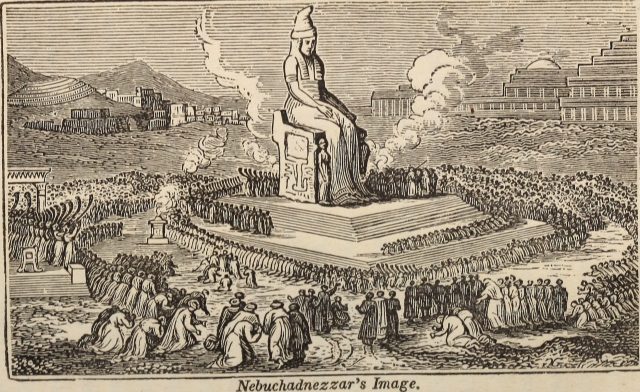
King Nebuchadnezzar made an image of gold, sixty cubits high and six cubits wide,and set it up on the plain of Dura in the province of Babylon.

Then the herald loudly proclaimed, “Nations and peoples of every language, this is what you are commanded to do: As soon as you hear the sound of the horn, flute, zither, lyre, harp, pipe and all kinds of music, you must fall down and worship the image of gold that King Nebuchadnezzar has set up. Whoever does not fall down and worship will immediately be thrown into a blazing furnace.”
Daniel 3:1, 4-6 (NIV)

When I was a kid growing up in Des Moines the tallest building on the skyline of our city was the Ruan building. “In rust we trust,” was the phrase I heard muttered by locals back in the day, inspired by the rusted steel skyscraper. Then, The Principal company built their even taller marble and glass skyscraper at 801 Grand. I will never forget that, as the new Principal building was completed, Mr. Ruan held a press conference to announce plans for a new building that would be even taller (it never happened). I believe that’s what is colloquially referred to as an “edifice complex.”

Last night I kicked off a Wednesday night class in which we’re exploring how God uses metaphor (something that represents something else without using “like” or “as”) to effectively express Himself and communicate Truth. We are also pushing into how we express ourselves metaphorically and how we can use metaphor to become better communicators. My assignment to the class in this first week was to look for metaphors in our daily life and bring one example back to class to share. One of my class-mates asked me for an example.

Wendy and I are in the final weeks of watching our house being completed, and yesterday I spent an inordinate amount of time contemplating knobs. We had to pick out the drawer and cabinet pulls for every room in the house. Talk about much ado about nothing. It was not an enjoyable process for me. Nevertheless, as I considered the endless options and how we were ever going to decide, I came back to some guiding principles that have emerged as we have designed our new residence.

“Clean, simple lines” is the phrase that always comes to my mind. From the start we have wanted our house to have a peaceful yet beautiful simplicity that invites people in to rest, to dine, to drink, to converse, and to comfortably be. So, I found myself looking for knobs that were simple, with clean lines and yet beautiful in their simplicity. That’s metaphor. The knobs we chose are an expression of the environment we desire our home to be. If we had chosen solid gold decorative knobs encrusted with gems and inlaid painted ceramic highlights we would have been expressing something much different with our choice.

nebuchadnezzars statueThose knobs came to mind again this morning as I read about Nebuchadnezzar’s great statue. How fascinating that in just the previous chapter King Neb has a dream about a statue and Daniel interprets that God is eventually going to replace Neb’s kingdoms with other kingdoms culminating in an eternal one. Now, the king builds a real statue and tells everyone to worship it. Why? Because he can. The statue of his dream and its interpretation rattled his pride, ego, and false sense of power and security. He responds by creating his own statue and making everyone bow and worship it in order to shore up the cracks in his fragile ego. The statue on the plain of Dura expresses is his own version of an edifice complex and becomes a metaphor expressing both his ego, power, as well as his fear and insecurity.

Today, I’m thinking about the edifice that Wendy and I are building out on the edge of town. I’m praying that it will express what we have talked about and intended all along: invitation, warmth, beauty, cozy hospitality, creativity, peace, and love.

Chapter-a-Day Daniel 3

Shadrach, Meshach, and Abednego answered King Nebuchadnezzar, "Your threat means nothing to us. If you throw us in the fire, the God we serve can rescue us from your roaring furnace and anything else you might cook up, O king. But even if he doesn't, it wouldn't make a bit of difference, O king. We still wouldn't serve your gods or worship the gold statue you set up." Daniel 3:16-18 (MSG)

Faith is acting on the belief that God is God and God is good, whether or not He has done or will do what we ask and desire.