Tag Archives: Caucuses

Flyover Country

Jesus replied, “Let us go somewhere else—to the nearby villages—so I can preach there also. That is why I have come.” So he traveled throughout Galilee, preaching in their synagogues and driving out demons.
Mark 1:38-39 (NIV)

Other than a four year sojourn to the outskirts of Chicago for college, I have lived my entire life in Iowa. As I network for work with business people on both coasts, I find that most people a) don’t know exactly where Iowa is on the map and b) have never been here. Iowa is known as “flyover” country. Business, politics, and culture in America are driven primarily by people on the either coast. Here in Iowa It’s mostly rural farmland dotted with small towns. We’re an easy target for comedians. The only reason anyone pays attention to Iowa is our first in the nation caucuses every four years that kick of the presidential race, and every four years the important and elite talking heads on the coasts gripe in the media about us having that little sliver of the political pie.

In the 40-plus years that I’ve been studying this Great Story from Genesis to Revelation, one of the things that I find lost on most people is the giant cultural divide between the worldly powers of Jesus’ day and where Jesus chose to begin His earthly ministry. For those living in Judea, the center of everything elite and important was in Jerusalem. The city of Jerusalem was New York, L.A., and Washington D.C. rolled into one. Just as people flock to those centers of business, politics, and entertainment to “make it” in the world today, so would those who wanted to “make it” in Jesus day go directly to Jerusalem. Every one who was anyone of power and prestige was in the big city.

The north shore of Galilee, on the other hand, was the “flyover” country in its day. That’s where Jesus chose to begin his ministry. When I visited the area I was amazed how remote it still feels today. To get to some of the little villages where Jesus taught we had to navigate back-country roads to places it’s obvious few people ever visit. It’s remote, isolated, and about as far away from “worldly power” as one could get.

Today our chapter-a-day journey begins a trek through the gospel of Mark, written by a man named John Mark, who has his own interesting story. Mark was a young man when his mother, Mary, became a follower of Jesus. He was among the throng of followers who are often forgotten in the shadows behind The Twelve who got most of the attention. Mark’s mother was among the women with means who financially supported Jesus’ ministry and in the events after Jesus’ crucifixion and resurrection, Jesus’ disciples and followers met at and lived in Mary’s home. Mark is in the background of most of the events of those early years of the Jesus’ Movement. He was with Paul on the first missionary journey, spent much of his adult life living with and assisting Peter. At the end of Paul’s life, Mark is there by his side.

I felt a spiritual connection between person and place this morning as I meditated on the first chapter of Mark’s biography of Jesus. Jesus chose to center His ministry in a rural area dotted with small villages of simple people just trying to catch fish, grow crops, and survive. Jesus’ followers were, for the most part, blue-collar workers with little education and zero prominence in the world. People like Mark, who was just a kid whose mom decided to follow Jesus, and so he lived his life in the background of events that would change the world. He was a stage-hand in the drama of the Jesus Movement – listening, learning, and then sharing Jesus’ teaching. Just one of those names in the program to which no one really pays attention.

And, I think this is the point. Through the prophet Isaiah, God said that His ways are not our ways. He doesn’t do things the way Wall Street, Washington, Hollywood, or Silicon Valley believe that things should be done. God sent His Son to flyover country to simple people living in rural areas who are just trying to make a living and figure out life.

I find something endearing and profoundly significant in this, especially in a culture where popularity, fame, and influence have become the currency of power in an online world that has become an endless cacophony of voices. Jesus’ message has never broadly resonated in the power centers of this world where the kingdoms of politics, education, commerce, and even religion hold sway. I am reminded that at the very end of the Story in Revelation, those kingdoms will still be lined up against God.

And so, in the quiet this morning, I sit in flyover country. Few people can find me on a map, and most people will avoid visiting. The further I get in my life journey the more I appreciate it. Jesus taught that I should seek first the Kingdom of God. Along life’s road I discovered that the closer and more enticed I become with the Kingdoms of this world, the harder it becomes find the eternal treasures that Jesus said were most important. I think Mark understood this. What a great role model; Living life in the background listening, learning, and sharing Jesus’ teaching among simple people who are just trying make a living and figure out life.

If you know anyone who might be encouraged by today’s post, please share.

The Difference a Dinner Makes

So [the king of Israel] prepared a great feast for the [Aramean soldiers], and after they had finished eating and drinking, he sent them away, and they returned to their master. So the bands from Aram stopped raiding Israel’s territory.
2 Kings 6:23 (NIV)

As Wendy and I sit each morning over breakfast and peruse the news of the day, we will often discuss different politicians or other individuals making headlines. Of course, there are always certain individuals for whom we have a certain affinity but we don’t always have the most glowing impressions of other individuals.

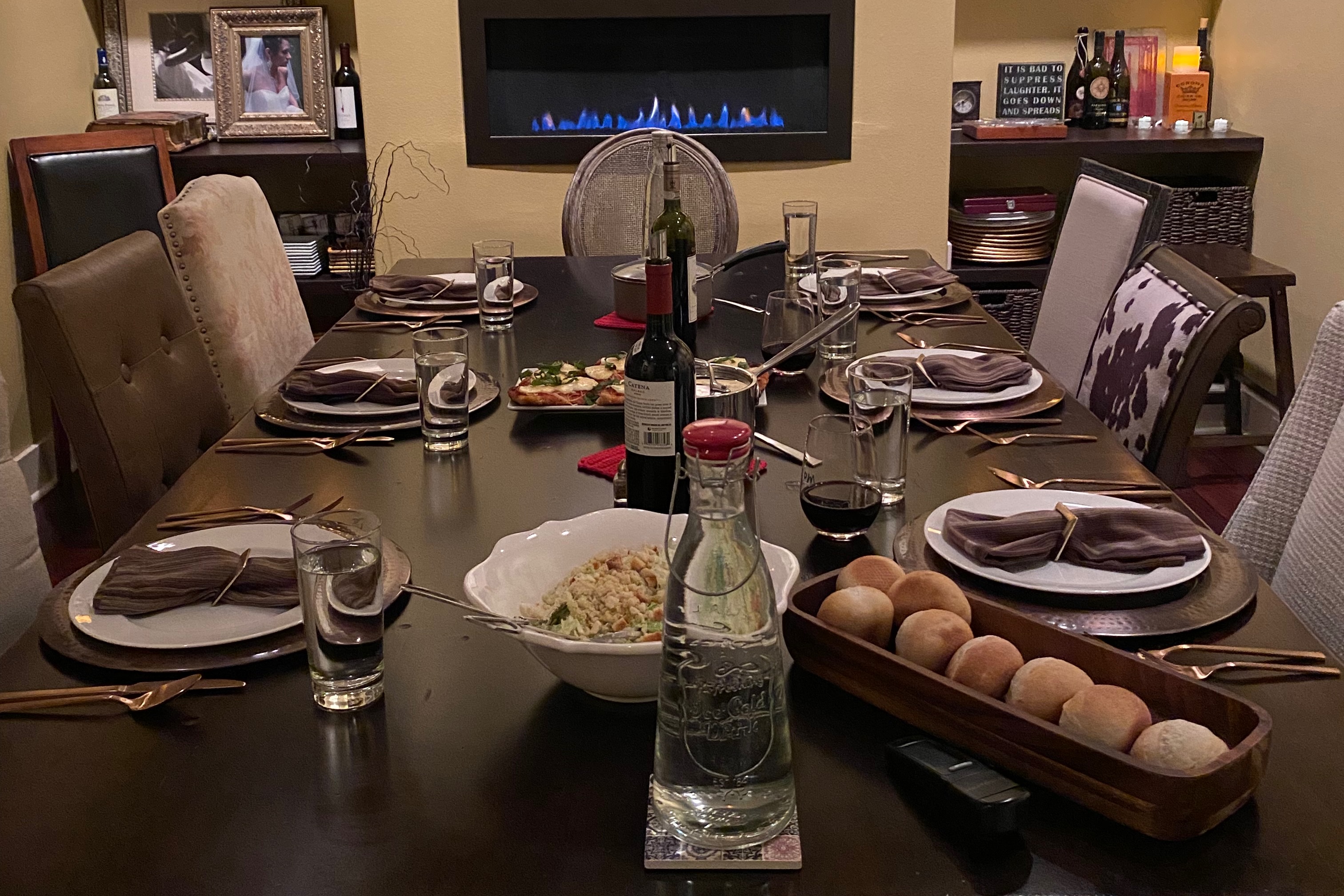
I’m not sure how and when this happened, but Wendy and I will commonly discuss the notion of having said individuals over for a meal. I think this idea began during a Presidential campaign years ago. A few months ahead of the Iowa Caucuses you can’t spit without hitting a visiting presidential candidate. One year when the number of candidates was off the charts, Wendy and I discussed the idea of how nice it would be to actually have each of the candidates (from any/all parties) over for dinner one at a time. It’s easier to really get to know a person over a good meal and good table conversation. Somehow, the idea stuck and now it comes up quite regularly in our conversations, what it would be like to have so-and-so over for dinner.

Today’s chapter is filled with extreme events from the miraculous to a horrific human tragedy. I have no recollection of this quiet little episode stuck in the middle. The kingdom of Aram shared a border with the kingdom of Israel, and bands of Aramean soldiers were constantly raiding the towns of Israel. Elisha miraculously blinds one of these raiding parties and leads them straight into Samaria, the capital city of Israel. When the king of Israel suggests killing them, Elisha instructs him to treat them to a feast instead.

So, the king of Israel treats the enemy soldiers as honored guests. They sat around the table and enjoyed a feast together. I imagine they swapped stories, laughed together, and got to know one another to a certain degree. The Arameans, knowing they could have been killed, were treated the way Jesus would later instruct His followers to treat our enemies, by blessing those who intend to persecute us. The result? The border raids stopped.

In the quiet this morning, I am reminded of the conference Wendy and I attended this past week that addressed some of the most controversial and divisive topics of our day. One of the most powerful things that the conference accomplished was to share the complex and intimate stories of individuals struggling at the heart of the issue. When issues are translated into human stories, it changes both my perceptions and understanding of the issues themselves. It’s the same principle that the king of Israel and the Aramean soldiers discovered. They came to bust heads and instead broke bread. It changed their attitudes and behavior toward their enemies.

(BTW: Another Presidential election cycle begins later this year. For any candidate who happens to read this, there’s an open dinner invitation here at Vander Well manor! 😉)

If you know anyone who might be encouraged by today’s post, please share.

A Cynic’s Confession

I urge, then, first of all, that petitions, prayers, intercession and thanksgiving be made for all people— for kings and all those in authority, that we may live peaceful and quiet lives in all godliness and holiness.
1 Timothy 2:1-2 (NIV)

When you live in Iowa, you get a larger dose of American presidential politics than most. Iowa is the first state in the parties selection process for presidential nominees. Therefore, Iowans tend to have a more generous dose of candidates, surveys, and political ads before everyone else. I kind of like it, in the general sense. About 95 percent of the time the major media outlets ignore us here in flyover country. If there’s not a tragedy, natural disaster, or the need for a heart warming Americana story, then they prefer to keep their cameras and microphones grounded on the coast. It’s nice to have the opportunity for our thoughts and opinions to matter for a few months.

At the same time, I will admit that the whole presidential circus gets a bit silly at times. I was once avidly involved in the political process, but confess that I have become jaded and cynical the further I’ve progressed in life’s journey. I vote regularly and do my civic duty, but I am increasingly appalled at how elected leaders look out for themselves and leverage our collective future to solidify their personal standing in the present. I’m talking both sides of the aisle here.

As I read Paul’s admonishment to pray for “all those in authority” this morning, I was struck by just how cynical I’ve become. It’s almost to the point of being a fatalist. If I’m truly honest, I have to admit that I find myself thinking, “What will be will be and my prayers, petitions, and intercessions won’t make a bit of a difference.”

Then, I think of Paul and Timothy out there under Roman occupation  and sandwiched between persecution from both Jewish authorities and Roman authorities. Theirs was not a representative republic. They didn’t have a vote. The media of the day was not surveying everyone in Ephesus to find out what they thought, and Caesar was not pandering to the backwater Hellenists. Their political impotence was far greater than mine, and still Paul urged vigilant prayers for all in authority.

Today, I’m a bit humbled to admit how hard my heart has become towards those in governmental authority. I am revising my prayer list. If you’ll excuse me, I have a few petitions to bring before the highest authority of all.