Tag Archives: Camp

Last Day of Camp

Keep your lives free from the love of money and be content with what you have, because God has said,
“Never will I leave you;
    never will I forsake you.”
Hebrews 13:5 (NIV)

Summer camp is always a special place to be. Both as a camper, and later as a leader, and guest speaker, I have such fond memories of the laughter, adventure, friendships, and fun. For some, that fun never ends. There are entire summer camp communities where adults and families spend summers “at camp” where worship, studies, activities, and relationships become part of the rhythm of summer their entire lives.

Nevertheless, summer always ends. There is always that final day of camp. The camp fires become the embers of memory. The guitars are in their cases. The cabins have been emptied. The beds stripped. The close friendships forged in the intense togetherness (and maybe even a sparked romance) must come to an abrupt end. Cars arrive to take campers back to their disparate hometowns. Campers return to their daily routines. It is the death throes of summer, when in one moment the fun seems to end with gut punch. As you hug these people who have come to mean so much to you in such a short period of time, you know autumn’s descent is imminent. All of the real life activities and responsibilities that come with it await.

I have a very vivid memory of lying in the backseat of our family’s Mercury Marquis station wagon (yes, complete with wood paneling on the side) driving home from camp. Tears streamed down my cheeks. They dripped down on the car’s brown carpet littered with gum wrappers and spilled McDonald’s french fries. I didn’t want to go back. I wanted to live at camp forever.

Today’s final chapter of Hebrews reads like the last day of camp. No lofty theology now—no soaring angels, no mysterious Melchizedek, no blazing heavenly tabernacle. Here at the end, the gospel comes home, rolls its sleeves up, and gets practical. Earthy. Intimate.

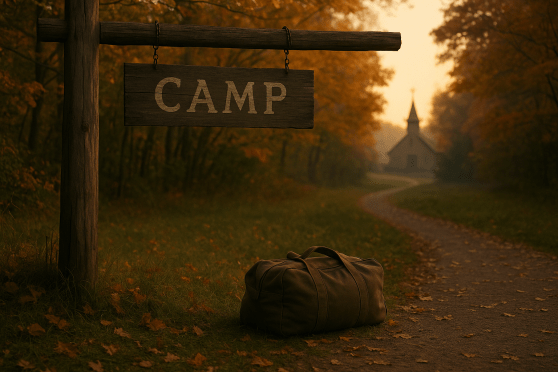
The car is running. Your duffel bag of dirty clothes and life-long memories is already in “the way back” of the station wagon. Mom and Dad are waiting as you say your good-byes. The camp counselor who has become like a big brother or sister leans down to face you intimately. Lovingly taking your face gently in both hands, looking directly into your eyes, your counselor whispers, “Everything we’ve journeyed through together? Everything we learned? Everything we talked about in our cabin’s middle-of-the-night heart-to-hearts? Now live it.”

Today’s chapter is a heart-felt list of loving marching orders from a camp counselor to a tearful camper who doesn’t want to return to “real life.”

Love as everyday liturgy

“Keep on loving one another as brothers and sisters.”

The Greek implies continually, habitually—love not as an emotion but as a practice. Prisoners become kin. Marriage is honored, not as a cage, but as a covenant shelter. The chapter opens like it believes the mundane moments are sacred ground.

Life free from fear

“Be content… for God has said, ‘Never will I leave you; never will I forsake you.’”

It’s God whispering,
“Even if the world shakes, I’m not going anywhere.”

Remember your leaders

The writer encourages the church to imitate the faith of leaders whose lives embody Jesus.

Not heroes on pedestals—humble guides whose walk matches their talk. Like the camp counselor who was just a college kid making less money than he could have behind a fast-food counter.

Jesus: yesterday, today, and forever

It’s the spine-tingling line. The center of gravity for the whole letter.

Everything changes—priesthoods, covenants, temple curtains, seasons in the heart. And summer, too. There’s always a last day of camp.

But Jesus?
Steady as the sun.
Always the same warm presence, the same mercy, the same fierce love.

The strange altar of grace

The author points to Christ as our once-for-all offering outside the camp.
Outside the religious system. Outside the institutions and walls of the church. Outside the boundaries of status and purity.

There’s an invitation and encouragement for unkempt daily life:
“Meet Him where it’s messy. Worship Him with your life, not rituals.”

The Benediction

“May the God of peace… equip you with everything good for doing His will.”

There is no demand from a tyrannical God. It’s not a shaming you into obedience. Equip you. Like handing you warm gloves for the road home and the inevitability of autumn’s cold winds and the impending winter you know follows right behind it.

Finally: “May He work in us what is pleasing to Him.”

Not me working for God.
God working inside me.

It’s divine intimacy—God and me, heart-to-heart, breath-to-breath.

In the quiet, as I meditate on these things, Holy Spirit takes my face lovingly into both hands and looks me in the eye. Returning to the words:

“Never will I leave you;
    never will I forsake you.”

The original Greek in which this was written has no English equivalent for the structure. It’s a triple negative. It’s like repeating the word “never” three times. One source I found paraphrased it like Jesus saying this:

“I will never ever ever let you go—nope, not happening, not now, not ever.”

And so, with that encouragement from Holy Spirit, my camp counselor, I slip into the back seat of life’s Mercury Marquis station wagon and head into the real life of this new day. Some days, I just don’t want to do it.

But I have my marching orders, and I’m never alone.

If you know anyone who might be encouraged by today’s post, please share.

Perpetual Embers

A perpetual fire shall be kept burning on the altar; it shall not go out.
Leviticus 6:13 (NRSV)

My family vacationed at the same place every year. Camp Idlewood on Rainy Lake in Minnesota was where we spent two weeks in early August every summer. There was a campfire pit just outside the boathouse and a fire was lit every night as families gathered around to swap stories, sing songs, and enjoy each other’s company.

As childhood gave way to the tween and teen years, we were allowed to stay later and later at the campfire. Eventually the parental unit would head to bed and we were allowed to hang out at the campfire until the wee hours of the night. Occasionally the wee hours gave way to dawn and we would still be there huddled around the fire pit.

I remember those nights watching the fire evolve from blazing bonfire to glowing embers. Still, we would stoke it and tend it and keep it going through the watches of the night as conversations continued, friendships were forged, and camp romances occasionally were sparked to life and then quickly went out.

I thought about that campfire as I read this morning of the ancient sacrificial fires prescribed by God through Moses. They kept going. Wood was added. The embers were stoked. The spiritual conversation and relationship continued around the fire.

This morning I’m reminded that my worship, my sacrifice, and my offering to God is not a compartmentalized act confined to a Sunday morning. It is a campfire in my spirit which does not go out. Every day, every stretch of the journey it blazes, it ebbs, and I tend to it;  I stoke the embers into flame again and again. God and me perpetually around the fire through the watches of the night, into the wee hours, and on to the dawn.