Tag Archives: Babel

Me and Babel 2.0

Me and Babel 2.0 (CaD John 17) Wayfarer

My prayer is not that you take them out of the world but that you protect them from the evil one. They are not of the world, even as I am not of it.
John 17:15-16 (NIV)

Earlier this year Wendy and I were on the back patio with friends late into the evening. One of the things we like to do in the dark of night is keep our eyes peeled for meteors, satellites, constellations, plants, and other interesting objects in the night sky. On that night I spotted a satellite, which basically looks like a moving star, trekking slowly from west to east. Then there was another one right behind it. I’d never seen two of them so close and moving in the same trajectory. Then came another, and another, and another, and another.

Pulling up the internet on my phone to find out what we were looking at, we learned that evening about the satellite train. The brainchild of Elon Musk’s SpaceX, it is a long string or “train” of 60 satellites that follow one another in orbit. SpaceX plan to eventually have 12,000 of them in low orbit to provide internet service everywhere from space. Fascinating.

It’s an amazing time to be alive and to make this earthly life journey. In the course of my lifetime, the world has arguably changed more rapidly and drastically than in any other time in human civilization. Advancements in technology and science are beginning to outpace our ability to comprehend the effects of all that it possible.

Along with the “progress” has come a sharp decline in the number of people who adhere to traditional Christian belief systems or attend institutional Christian churches. One of the things that I read consistently about this trend is the criticism that believers and churches in America haven’t done enough to address social justice issues and the problems of our world.

Today’s chapter is traditionally known in theological circles as “the high priestly prayer.” John records Jesus praying just before He was betrayed by Judas and arrested. In the prayer Jesus acknowledges two important things. First, that His followers are “not of this world.” In my experience, Jesus is acknowledging that those who follow Him have expanded their world-view beyond this earthly life to God’s eternal Kingdom. After acknowledging this, Jesus consciously chooses that His followers not be removed from this world, but protected from the same prince of this world that will see Jesus crucified within twelve hours of this prayer.

To quote Hamlet, “ay, there’s the rub.”

In this world, not of it. How do I, as a follower of Jesus, hold that tension?

That’s what my soul and mind are chewing on in the quiet this morning. And here are a few of my thoughts…

I confess that critics of Christianity are not wrong. Followers of Jesus and the institutional churches of history have not done enough adhere to personally fulfill Jesus’ mission of crossing social boundaries, loving the outcast, and caring for the poor. Mea culpa.

At the same time, history has taught me that revolutions and reformations typically paint complex realities with broad-brush generalizations, and then throw babies out with the bathwater. Despite the moans and wails of how awful of a state the world is in, here are a few undisputable facts:

  • In 1966 (the year I was born), 50% of the world’s population lived in extreme poverty. In 2017, that’s dropped to 9% despite population growth.
  • When my parents were young, average life expectancy was between 30-40 years. In two generations it’s risen to 72, and still climbing.
  • In 1975, 58% of children with cancer survived. By 2010, it was 80%.
  • In 1980, 22% of one-year-olds received at least one vaccination. In 2018 the percentage was 88%.
  • In 1970, 28% of the world’s population was undernourished. In 2015 that number had dropped to 11%.
  • In 1900, roughly 40% of children died before the age of five. By 2016 the percentage was down to 4%.
  • In 1980, 58% of the world’s population had access to a protected water source. By 2015 the number was 88% and climbing.

It’s easy to cast a stone at the institutional church, its members, and cast stones regarding all that it hasn’t done. I also know many believers in my own circles of influence who, led by their faith in Jesus and dedication to His mission, have given their lives to contribute to the numbers I’ve just quoted.

Scott and Marcia have helped mobilize native efforts in Eswatani Africa to care for unwanted babies, lower the spread of HIV, increase access to clean water, and improve agricultural yields to feed the local population.

Tim and an entire host of individuals in our local gathering of Jesus followers have done a similar work in Haiti. Learning from the mistakes of the past, they are helping native Haitians create sustainable and healthy life and community systems.

My college suitemate, Tim, has dedicated most of his career to helping care for impoverished children and single mothers around the globe. He’s now leading a non-profit to address the 12% of the world’s population that still need a protected water source.

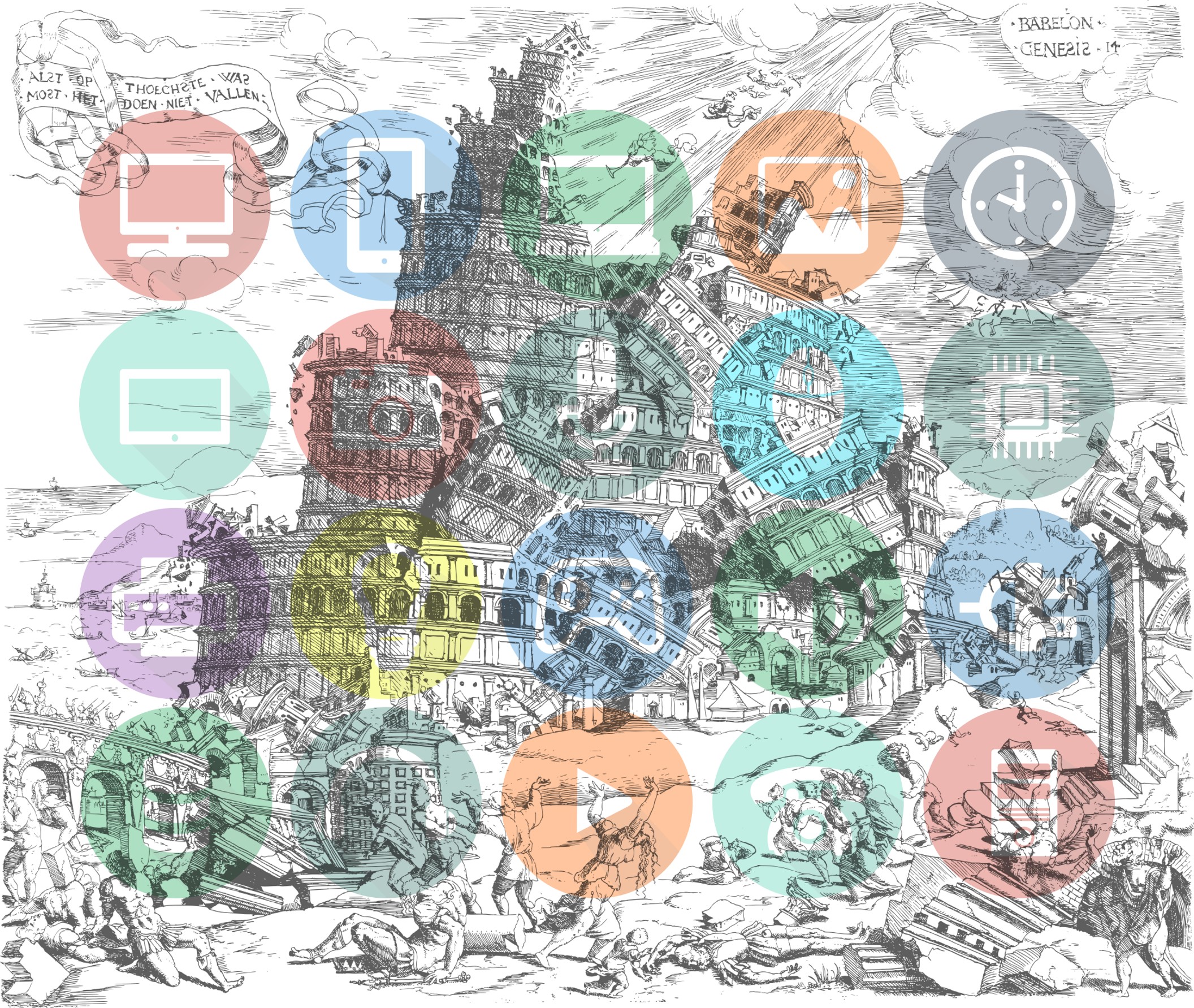
I have long believed that with the technological age I may just be witnessing humanity’s next great attempt at building a tower of Babel. Instead of bricks and mortar, we’re using processors, fiber optics, CRISPR, and satellite trains. The goal is the same: nothing is impossible, and we ascend to be our own god. I find it fascinating to observe what I perceive to be “Babel 2.0” is that we largely still speak the same language but our transmission and translation are increasingly confused. What one intends to say, what they say, and what the other hears and interprets to have been said are incongruent. Language is hijacked and redefined in a moment by part of the population. New words are created, defined, and trend within one part of the population while everyone else in the population failed to notice. They are therefore ignorant and confused when they are discussed.

So what does this mean for me today? I don’t run an institution, nor do I want to. I am a follower of Jesus and, as such, I have a world-view that sees beyond this world and incorporates God’s Kingdom into my earthly existence. I seek to accomplish His mission of “your kingdom come, your will be done on earth” and I take that responsibility seriously. This earthly journey is not about biding my time until death and eternity, but rather trying to bring a Kingdom perspective into my every day intentions, choices, work, actions, and relationships.

I am in this world, a world which remains the dominion of the prince of this world, which is why Jesus prayed for my protection on that fateful night. Jesus asks me to affect this world with love, service, and generosity that He exemplified. He told His followers to be “shrewd as a serpent and gentle as a dove.”

And so, I enter another day of the journey with those intentions.

Note:
Three messages have been added on the Messages page. Click here

If you know anyone who might be encouraged by today’s post, please share.

Words That Reach to What Was, and Is, and Yet Will Be

How you have fallen from heaven,
    morning star, son of the dawn!
You have been cast down to the earth,
    you who once laid low the nations!
You said in your heart,
    “I will ascend to the heavens;
I will raise my throne
    above the stars of God;
I will sit enthroned on the mount of assembly,
    on the utmost heights of Mount Zaphon.
I will ascend above the tops of the clouds;
    I will make myself like the Most High.”
But you are brought down to the realm of the dead,
    to the depths of the pit.
Isaiah 14:12-15 (NIV)

The language of God is metaphor, and metaphors (e.g. word pictures) are layered with meaning. That’s what makes them so powerful as a tools of communication. Their meaning resonates far deeper and reaches much further. Metaphors are layered with meaning. Like God, you keep mining the depths only to find there is more there than you ever realized before.

That is often what makes the words of the ancient prophets both confusing and powerful. Take the words from today’s chapter pasted above as an example.

Let’s start with the first layer of meaning: Isaiah’s prophecy concerning Babylon. Babylon was an aspiring superpower and becoming the largest city on Earth. Babylon was swallowing up peoples and territories. Babylon was swelling with pride at its greatness. One day its king, Nebuchadnezzar, would literally fulfill the sentiments cited by Isaiah (Read Daniel 4).

But let’s also go back in time and remember the root of Babyl-on. Think Babel. The story in Genesis 11. The people said, “Let’s make a city with a tower that reaches to the heavens and make a name for ourselves.” It’s the same root of pride. The same sentiment.

Let’s go back further to the Garden, where the serpent tempted Eve and Adam with the notion that they could eat the fruit and “be like God.”

Many commentators have said that Isaiah’s prophecy reaches further back and refers to Satan, or Lucifer, who tradition tell us was God’s most beautiful angel. Lucifer wanted to be like God and was cast from heaven to inhabit death. Again, the sentiment is the same. Wanting to ascend to the place of God. The same sentiment with which he tempted Adam and Eve.

Think forward to the prophecies of John in Revelation, in which he sees a woman, “Babylon the Great,” sitting on a beast covered in blasphemies.

Things that were. Things that are. Things that yet will be. The thread is the same: that which sets itself to ascend in its pride and become God, therefore diminishing God of all that God is (and was, and is to come).

And that’s where my heart settles in its meditation this morning. Where do the seeds and fruit of pride – those same seeds of Lucifer, of Adam, of Nebuchadnezzar, and of Babylon – show their roots in my heart and life? In what ways do I seek to be god of my life, my relationships, my spouse, my children, my business, my house, my possessions? Where does my pride ascend in thinking I create, conquer, possess, control, and/or dominate?

In what ways do I, in contrast to John the Baptist, seek to become more and make Jesus less?

Isaiah was writing about the nation of Babylon, but his word picture is layered with so much more meaning. His word picture stretches back before creation. It stretches forward to that which yet will be. It stretches forward in time to this morning, in this place, at this moment and ask this person to contemplate both the evidence of my pride, and my desperate need to seek humility.

More, Faster

Be patient, therefore, beloved, until the coming of the Lord. The farmer waits for the precious crop from the earth, being patient with it until it receives the early and the late rains.
James 5:7 (NRSV)

The culture I have known my entire earthly pilgrimage is one of instant gratification. In comparison to my childhood, the world I now experience on a daily basis is instant gratification on steroids. Things just keep moving at increasing speed. This is not the musings of an aging man, but the realities of a culture rebuilding Babel with Cat-5 cable and DNA strands.

When I was 5 I received an “electronic football” game for Christmas that was nothing more than a vibrating panel with little plastic men moving chaotically around the bouncing cardboard panel. Sometimes the “running back” with the magnetic ball on his base would spin around in circles. Sometimes he turned around and vibrate to the opponents end zone for a safety. I was, nevertheless, mesmerized by the experience.

When I was 10 I was playing a hand-held “Mattel Electronic Football” game that was nothing more than little red blips on a tiny screen which would switch on and off representing players (see featured image). I played it for hours, those red blips transformed by  my imagination into the Minnesota Vikings winning the Super Bowl.

When I was 30 I was playing football as a video game on my home computer. The black and white, heavily pixelated graphics seemed revolutionary. Now the computer could simulate actual players, teams and leagues and keep track of my stats across an entire fantasy season.

When I was 40 I had a gaming console playing a much more sophisticated and realistic video game version of football allowing me to play the game as a player, coach the team, or run an entire team franchise including roster moves and salary caps.

At 50 I can play electronic football that looks like a real television broadcast complete with commentary, and I can play against virtually any person, anywhere in the world from the comfort of my man cave.

This is just a trite example, of course. Yet, I can expand this example to almost everything I do during my day. I am growing increasingly used to getting what I want, when I want, and how I want it.

How is this affecting my spirit?

source: singularity.com

Throughout God’s Message we find example after example of people who waited. Noah built the ark and waited for years before it rained. Abraham and Sara were promised that their descendants would number like the stars in the sky, then waited for decades before their first child was born. Joseph, as a child, received a vision of his brothers bowing down before him then lived a lifetime of struggle, slavery, scandal and imprisonment before it was ultimately fulfilled. David was promised he would be king as an adolescent boy, then spent thirty years on the run with a price on his head before it would come to fruition.

I have learned along my journey that God’s sense of timing is not our human sense timing. Following Jesus and fulfilling our God-given purpose requires patience, waiting, and perseverance. These qualities are increasingly rare in a world in which I can order virtually anything I want from the palm of my hand and have it delivered to my door step within hours or days. Why on earth would I believe in a God who wants to groom me to accomplish His purpose for over 40 years when I can have my 15 minutes of fame on YouTube right now?

This morning I’m thinking about purpose and patience. In a world that keeps speeding up, I am realizing how critical it is for me to choose to slow down, breathe deeply, and be patient. God’s creation is about the ebb and flow of time and seasons. Humanity’s creation is about more, at increasing rates of speed. If I am going to embrace the former, I must consciously address the latter.

chapter a day banner 2015featured image source: dcjohn via Flickr