Tag Archives: 2 Kings 18

Sacred Things

Sacred Things (CaD 2 Ki 18) Wayfarer

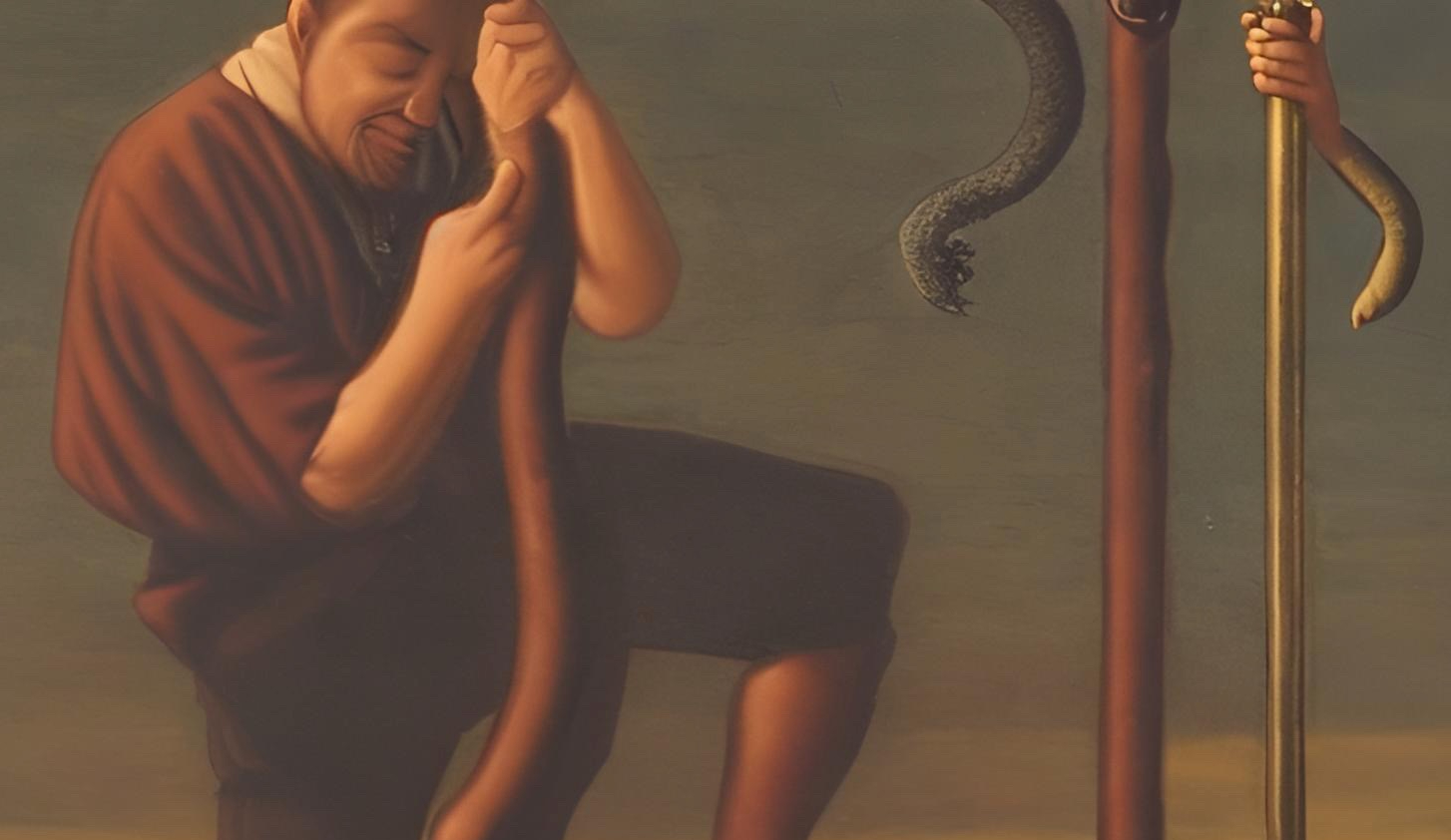
[King Hezekiah] broke into pieces the bronze snake Moses had made, for up to that time the Israelites had been burning incense to it. (It was called Nehushtan.)
2 Kings 18:4 (NIV)

Wendy and I had the joy of visiting a local high school yesterday to provide feedback on two student theatre pieces on their way to All-State contests this weekend. It was so much fun for us.

Before leaving, we got into a conversation with one of the teachers regarding the ways individuals get offended and bent out of shape by different things. It’s not unusual. In the years that I was President of our local community theatre, I got to field many calls and personal visits from people who were offended by this or that.

One of the things that I observed amidst the anger and the criticism I listened to is that people sometimes hold the most unusual things personally sacred – things I would never expect.

I’ve experienced the same with church. I remember once getting into hot water because the ratty, old, falling-apart King James pew bibles were replaced with new pew bibles in a more modern translation. The ratty, old, falling-apart bibles had become sacred to someone.

In today’s chapter, we begin the story of ancient King Hezekiah of Judah. As the author lists all of the things Hezekiah did to abolish idolatry in the kingdom, he mentions that people had been burning incense to a most unusual object.

Around 750 years before Hezekiah, Moses was leading the Hebrew tribes out of slavery in Egypt. Snakes were biting and killing the wandering tribes. God told Moses to make a snake on a pole out of bronze and anyone bitten by a snake could look at it and they would live. Fast forward to the days of Hezekiah (a time when snake worship was common), and individuals had begun worshipping the bronze pole rather than the God who miraculously used it for a specific purpose at a specific point in time to address a specific situation.

In the quiet this morning, I am simply reminded of the human tendency to make certain things sacred and worship them. I’ve observed people making sacred and worshipping homes, buildings (especially churches), children (deceased or living), ancestors, traditions (lots of these), memories, treasures, celebrities, hobbies, clothes, cars, et cetera.

It is especially easy for me to do exactly as the people of Hezekiah’s day had done. I can hold certain trappings of religion more sacred than the living God to which those trappings are supposed to point me.

So, what do I hold sacred? Are there things, other than God, that I actually worship without thinking about it in those terms?

If you know anyone who might be encouraged by today’s post, please share.

Note: The featured image on today’s post was created with Wonder AI

The Wisdom of Silence

But the people remained silent and said nothing in reply….
2 Kings 18:36 (NIV)

Wendy’s and my morning routine begins each day meeting in our dining room for breakfast. Our dining room looks east over our back yard and the field of prairie grass behind it. If the sun isn’t too bright we get to watch the sun rise up over the tree line as we drink our respective tea and coffee and catch up on the news of the morning.

Of late Wendy and I have been reading a lot about the outbursts that are happening all over the States from college campuses to the streets and parks of various cities. As most of us know, it spills over into social media where it seems one cannot share a reasoned, personal opinion without getting pummeled, insulted and threatened by strangers or people you barely know. Just a few weeks ago my friend Dr. Bob shared with me a brief glance at the vitriolic string of threatening comments and emails he’d received after his editorial appeared in the New York Times. We are living in reactive times.

During our quiet morning conversations Wendy and I have mulled over a couple of thoughts about this entire trend. First, at least in some cases the screams and conflict are meant to create a reaction and the press coverage that goes along with it. National attention is exactly what some groups desire to recruit like minded individuals and financial support. Second, we live in an unprecedented age of 24/7 news coverage from endless outlets competing for ratings and advertising dollars. These news outlets have a need for news they can report and keep audience attention. I wonder, at times, how complicit the media is in creating or sustaining the conflicts with their coverage to the point that it gets blown out of proportion compared to the reality of the situation. Finally, it has come to light that another country had agents trolling American social media during our election year stirring up reactive anger between those of opposing political views. They believed that the conflict would be destabilizing. Mission accomplished. Welcome to a new era of cyber warfare: stimulating your enemies to destroy themselves from within.

This came to mind this morning as I read today’s chapter about a very ancient conflict. The Assyrian empire was blitzing its way through the region. They destroyed Israel and were now at the gates of the walled city of Jerusalem. The strategy for thousands of years of siege warfare was for the raiding army to send its best communicator to have a parley with the besieged city’s leaders. The city officials would stand on the wall and the besieging army’s mouthpiece would stand below and yell up at them. The goal was to threaten, cajole, and intimidate those in the city into giving up.

The Assyrian commander comes to wall of Jerusalem and does his best to smack talk the people of Judah into fear. He tells them not to listen to their king, not to trust their God, and to look at how things ended up for their other enemies. For added effect he throws in that a long siege would result in them being so starved for food and drink that they’d eat and drink their own excrement.

But then the scribes record that the people said nothing. They didn’t react in anger. They didn’t talk smack back. They didn’t take the bait. They remained silent.

This morning I’m reminded that the teacher of Ecclesiastes wisely reminds us “there is a time to speak, and a time to be silent.” I’m reminded that when brought before the kangaroo court of His accusers bent on state-sanctioned homicide, Jesus remained silent. There is a time for discussion and reasoned debate. There are times to raise our voices in protest. But there are also times like the people of Judah before the Assyrian parley when we need the wisdom to be silent and ignore the taunts of others.

God, grant me the wisdom to know when to speak, when to be silent, and the discernment to know the difference.

[Now, if you’ll excuse me I have a breakfast date with Wendy down in the dining room.] Have a great week everyone.]

Chapter-a-Day 2 Kings 18

Then he stepped forward and spoke in Hebrew loud enough for everyone to hear, "Listen carefully to the words of The Great King, the king of Assyria: Don't let Hezekiah fool you; he can't save you. And don't let Hezekiah give you that line about trusting in God, telling you, 'God will save us—this city will never be abandoned to the king of Assyria.' Don't listen to Hezekiah—he doesn't know what he's talking about. 2 Kings 18:28-31a (MSG)

Taking a step back and looking at today's chapter and you find a great example of the ancient art of seige warfare. Seige warefare has been a lucrative enterprise throughout history and the Assyrians would have easily made the all-star team. It's bullying and extortion on a national level. You simply amass a large army, surround a weak city, and then demand a huge sum of money to back down. If the city refuses, you destroy it mercilessly (the Assyrians were known to hack the limbs off their victims and leave piles of disembodied arms and legs outside the city gate as a calling card). If the city was too big or well fortified, you simply waited and let the inhabitants of the city slowly starve to death and implode because you've cut off their supply lines. Of course, you make sure a few survivors make it out and escape to nearby towns so that the news of your terror psychologically begins to intimidate the next city on your list.

Part of successful seige warfare was the application of psychological pressure by continually taunting the surrounded city. It was the ancient form of talking smack that you still see on the football field or basketball court. If you can get inside your opponent's head, you have the edge.

I believe we all have experienced, even to a minimal degree, a feeling of being beseiged. It could be bullying on the playground, being the victim of the neighborhood gang, or being singled out and verbally beat down by a parent, teaching, coach or authority figure. I think that our spiritual enemy uses the same tactics: surround, cut off, harass, intimidate, and get inside the head.

The answer to a seige is perseverance, strong will, and a Deliverer.